Category Archives: Features

fun & games: Bunco girls gather for good times

Good friends. Good laughs. Good times. Bunco.

It’s printed on their black T-shirts with hot pink lettering.

But it’s more than just a catchy saying.

After 10 years, the expression rings true for this group of local women. Good friends gathering for a good time with a lot of good laughs playing a game called Bunco.

Playing together

Dice roll across wooden tabletops and echo throughout the room. The occasional bell rings. There’s talking. And laughter. Loads of laughter.

A group of local women began playing Bunco a little over 10 years ago. They live in several Nodaway County communities and include Julie Acklin, Rita Carroll, Keitha Clapp, Amy Derr, Nichole Dew, Pat Giesken, Melissa Grace, Diana Heitman, Shannon Heitman, Deb Henggeler, Becky Jones, Patty Neal, Marsha Price, Liz Schieber, Lori Snead and Barb Walk.

The idea for the Bunco group started with Price, who had a friend in college who played the game. She thought it would be fun to start a group here.

“Several years later, we finally had enough friends to play,” she said.

With most of the original members still, they get together the second Friday of each month and rotate hostesses and homes.

Outside of Bunco, some of the women work together, some play sports together and some of their children are friends, too.

The game’s history

According to the World Bunco Association, the game was originally called 8-Dice Cloth in the 1700s in England. It first came to the US in 1855 by a crooked gambler in San Francisco who called it Banco. A few years later, the name was changed to Bunco or Bunko.

From the 1880s until the 1920s, the game changed from one of gambling and swindling to a traditional family or parlor game with Bunco groups consisting of 8-12 people and even up to 20 who enjoyed an evening of fun, friendly competition and conversation. During the roaring ‘20s, Bunco gambling parlors became popular once again, but after prohibition, interest in the game declined.

Bunco made a resurgence in the 1980s and its following has increased steadily ever since.

Traditionally, most Bunco gatherings include 12 players with three tables of four players each. The game is one of luck, not skill, and is played with three dice. The object is to accumulate points by rolling certain combinations.

Creating memories

Cheers erupt from the girls who have gathered on June 8 at Grace’s home in Burlington Jct. “Bunco!” Clapping, high fives and more laughing.

In the last 10 years of playing, group members have created a lot of memories through their laughing and socializing.

The most unforgettable one came when they were playing at Jones’ house once and her neighbor’s home caught on fire. They donated the winnings that night to the victims of the fire.

In addition to the memories, they’ve also gotten to know each other better.

“When we get together, we tend to sometimes talk more than we play,” Melissa Grace said.

For most – if not all – the conversation takes precedence over the game, asking questions about one another’s families, children, jobs and lives.

“I come just to see these people,” Jones said. “Because I’m not very good at the game.”

And, of course, more laughter ensued.

For more information on Bunco, visit worldbunco.com.


Camper-turned-companion gives back to Camp Quality

The sounds of children laughing ring through the wooded campground on a steamy, summer afternoon.

Not an uncommon occurrence at a summer camp – kids laughing.

But it means something entirely different at Camp Farwesta near Stewartsville.

One week each June, the campground hosts Camp Quality Northwest Missouri, a local summer camp for kids with cancer.

This year, Camp Quality will mark its 27th year with a Superheroes theme from June 10 to 15.

A rare camper-turned-companion, Arianne Bredlow has grown up at Camp Quality, a place she calls her second home.

“Normally, some of the kids are very sick and feel down,” the 20-year-old Ravenwood resident said. “But seeing them be able to smile and laugh (at camp) is kind of an overwhelming experience. I think that’s just the neatest thing.”

It’s a week where they can forget about everything wrong with them, she said, and just be themselves.


Her camp experience 

Bredlow was diagnosed with retinoblastoma in her right eye when she was only seven months old. She had four operations within the first year of her life, and in one of those, doctors removed her right eye.

She had her last operation in January 1992 and was considered cancer free.

“I have an artificial eye now and that’s basically the only thing I have left of my cancer,” she said.

Her first Camp Quality experience came at the age of five, and after 13 years as a camper, Bredlow said she feels grateful for the camp where kids with cancer can be kids again.

“I got teased a lot and that was a place where everyone’s the same,” she said. “It created a second family for me.”

Her years at Camp Quality also changed her as a person.

“I’m more willing to go out and do things because they’ve said, ‘hey, you’re still a real person, don’t let this affect you, don’t let it bring you down, do what you feel you want to do,’” she said. “It’s helped me grow a lot.”

It can also take an emotional toll on both campers and companions.

“You develop different relationships,” she said. “And sometimes they don’t come back to camp. Sometimes the campers do pass away and that is very hard.”


Her volunteer efforts

Bredlow graduated from Camp Quality in 2008 and returned to camp two years later to volunteer as a companion.

“I kind of felt I owed it back to some child who has cancer,” she said, “because I was given so many opportunities and had so many different experiences that I wanted to give that to another kid.”

Camp Quality matches each camper with a volunteer companion. Throughout the entire week, the two spend nearly all of their time together. The companions assist campers with things like arts and crafts, fishing and horseback riding.

They also do other typical summer camp activities like flag raising, singing camp songs and having campfires. They participate in special events, dances and talent shows and are entertained by magicians and hypnotists.

In addition to companions, Camp Quality depends on other volunteers to help out during the week, like cooks, medical staff and the camp’s directors.

“It’s really neat to see how many volunteers give up their time and their jobs for a week,” she said.

The camp also relies on fundraising throughout the year. Many organizations from all over Northwest Missouri donate to the cause.

“Those fundraisers help pay for so many things,” Bredlow said.

Since she understands how important the camp is to the kids, she also helps out with raising money. She assists with the local radio-a-thons held each year, and earlier this spring, she participated in her first 5K which benefitted Camp Quality.

Bredlow will serve as a companion again this summer along with several other volunteers from the Nodaway County area. She said she plans to continue to volunteer and raise money for Camp Quality for as long as she is able.

“I can’t imagine my life without Camp Quality,” she said.

For more information on volunteering or to donate, visit campqualityusa.org/nwmo or call 816.232.2267.


The loom lady: a love affair with walnut and wool

I love walnut and wool.

She says it in passing, almost as a whisper, but with a real sense of conviction.

If there is a nook or a cranny anywhere in Lucille VanSickle’s Clearmont home, it is filled with walnut and wool. Something she has created. Or rather, woven.

Projects finished. And projects just begun.

And looms, looms everywhere.

Warmth radiates from her weavings throughout her home, a reflection of the 90-year-old VanSickle, who believes having an interest in things has kept her young.

VanSickle grew up in Elmo and has lived most of her life in Nodaway County. She moved to Clearmont in 1967 with her late husband, Andy.

Her love for walnut and wool began a few years later, in the early 1970s, with an art class in Maryville.

fascinated by it

She had previously taken some adult art classes that hadn’t interested her much until a lady from Columbia came up to do a night class in weaving.

“I was fascinated with it,” she said.

The instructor let her take a loom home, so she did, and she was hooked.

“Some of those women bought looms and then put them in the attic. I never let mine rest,” she said. “It’s just been a real joy.”

Her adventures in weaving began with a big rug loom, making over 100 rugs for a church near Skidmore to sell at their bazaar.

“Then I got interested in lots of other kinds of weaving,” she said.

And her initial fascination transformed into a way of life.

In addition to the rugs, she has woven bags, belts, scarves, coverlets, pillows, baskets and wall hangings. She even tried her hand at Kumihimo, a method of braiding silk threads originally used by Japanese warriors hundreds of years ago, where they wove secret patterns around their sword handles.

“If you study the history of it, man has been weaving since our earliest history,” VanSickle said. “Every country has their own style of weaving. And that’s been fun to study.”

captivated by it
Her love of weaving has gone beyond just the art and the learning. She has been captivated by the looms themselves.

She has three big workable floor looms, two table looms and countless little box and cardboard looms. She has also had great big barn looms, measuring six to seven feet tall, and she even made a loom out of a gas pipe.

“There’s no way to count them all,” she said. “I enjoy making the looms and restoring old ones.”

Some of her greatest joys have been in finding an old loom, repairing it and getting it to “come alive again,” she said, like her first big barn loom.

She went to an auction where she was told there were big loom parts at an antique store in Cameron.

“I had a big old yellow Plymouth station wagon,” she recalled. “As soon as I could, I just drove clear to Cameron.”

When she arrived, the owner told her that there were indeed pieces of a loom out on the back porch.

“There was this whole pile of walnut lumber,” she said. “We loaded that walnut loom in the back of that Plymouth and it just went way down low in the back, so I had to drive home very slowly.”

And on the way home, she wondered what her husband would say about all that wood.

“I got it home, took it all out and got it cleaned up. And when my husband came home, he seemed delighted that I had made a good purchase,” she laughed, remembering that old loom. “I learned from that one. They’re each a little different and you learn from every one.”

animated by it

VanSickle lights up when she talks about sharing what she loves and what she’s learned over the years with others.

She becomes animated as she talks about teaching children to weave, about seeing the excitement in their eyes, about being a part of a local weaving group and also about attending the Midwest Weavers Conferences, where there are hundreds of people who, like her, are all excited about their art.

“One of the things I like the best is the friends you meet, other weavers, and sharing what I love,” she said. “Turning thread into something beautiful, making something useful and learning new techniques is fun. But then being able to share that learning with other people is a joy, too.”

Today, she continues on with her craft, just as excited as ever. Next on her list to tackle is learning how to weave clothing.

And it’s not surprising that she’s up for a new challenge.

Continuing her love affair with walnut and wool keeps her busy. And keeps her young.

“There’s food for your mind, food for your body and food for your spirit,” she said. “(Weaving) feeds my spirit.”


A day in the life of … a dairy farmer

“Come on, girls.” He whistles, pounds a piece of plastic piping on the barn’s concrete floor and calls them again. “Come on.”

The cows move from the milking equipment out into the field and 64-year-old Richard Groves slides the lever to let four more come into the barn and clangs it back shut.

I arrived a few minutes before 6 am and he walked out of the barn to meet me with a gentle smile and handshake. Rough farmer hands, but friendly. He apologized for having me out so early to his farm northwest of Graham, where he had already rounded up the cows from the field.

“We don’t start as early as some,” he said. “I’m not a morning person. I’d rather work all night long than get up early.”

But such is the life of a dairy farmer.

“It’s a good life,” he says, “but it’s a hard life.”

Crossing the gravel road through the dust my car stirred up moments before, the scent of freshly cut hay also lingers in the air. Inside the barn, steps lead down to where Groves moves efficiently to do the morning milking, with equipment straddling his work area on both the north and south sides of the building.

5:59 am: he turns a knob on a panel and releases feed from galvanized chutes, swings the lever to open the gate and brings four cows in on the north side of the barn, then closes it again. He pulls off five or six giant paper towels from a large roll hanging near the machinery, tears one off and shoves the others into the front pocket of his jeans.

He reaches for a bottle filled with a semi-transparent solution, walks over to the first cow and dips each teat into the container to kill any bacteria. He uses the paper towel to wipe them down and squirts a little milk out of each one.

He then proceeds to hook them up to the milking unit, which includes cups that remove the milk, milker claws where milk pools momentarily as it is removed, vacuum tubes that suction it through the pipes and a pulsator that regulates the cycle.

6:04 am: as soon as he finishes the north side, he spins around, whips open the gate on the south side, turns the knob to release more feed and brings in four more cows.

And the process of dipping, wiping, squirting and hooking them up begins again.

‘Jerseys on this place’

Groves has lived on this same land his entire life.

“I grew up right here,” he said. “My grandfather registered his first Jersey in 1897.”

He started as a young boy helping his dad and his granddad.

“There have been Jerseys on this place ever since I can remember,” he says while turning around to check on his first four.

6:08 am: he grabs another bottle, filled with a deep reddish-brown colored solution – iodine – to prevent disease. He unhooks the first four cows, dips the teats into the iodine solution, then prods the cows through the barn and out into the field.

6:12 am: he releases more feed with a quick turn, clangs the lever and brings in four more on the north. He closes the gate and then starts the process of unhooking the four on the south and releasing them out into the field.

6:14 am: knob turns, feed drops, cows eye it… waiting to be let in. He turns around and starts hooking up the ones on the north.

He moves effortlessly throughout the barn wearing boots, jeans and a brown T-shirt that reads “Milk Rules — there aren’t any.”

His dairy operation is one of only four left in Nodaway County, including the one run by Northwest Missouri State University.

And he said there are several reasons why he believes that is the case – the high costs of keeping up the farm and cattle, the swings in milk and feed prices and all of the rules and regulations they must follow. Plus, it’s a just plain, hard work.

‘one of the most tested products’

“We’re milking 56 head,” he says, which takes about an hour and 45 minutes to two hours to milk them all.

The process of milking each one, however, takes just a few minutes. From the milking unit, the milk travels through pipes and into a receiving jar and bulk tank.

Groves said they keep the milk at a 35 to 37 degree temperature and it gets picked up every other day by Robert’s Dairy in Kansas City. In that two-day timespan, they produce 3,500 pounds of milk.

“We’re down from what we were, but it’s starting to pick back up,” he said.

6:16 am: four more come in on the south, while several others wait right outside the barn, peeking through the gate, ready to get in.

6:23 am: north side off and out into the field.

Groves, who also serves on the Dairy Herd Improvement Association board, said the milk is bought by the Dairy Farmers of America.

“When the driver picks it up, he keeps a sample and it’s all tested,” he said. “Milk is probably one of the most tested products to make sure it’s safe for the consumer.”

Their facilities are also inspected every three to five months, overseen by the state milk board.

6:26 am: four more come in on the north.

6:29 am: the south ones go out.

For as hot and unbearable as the summer sun and humid heat can be on a farmer, the bone-chilling winters the Midwest is known for can be especially tough on a dairy farmer.

“When the weather’s real bad, you’re out (nearly) all day long,” he said.

The cows are kept inside, he said, which requires more work than when they’re left out in the field.

6:30 am: south ones in and hooked up.

6:32 am: north ones off and out.

The consistent flow of animals in and out of the stalls is surrounded by the repetitive, rhythmic sucking sounds, an exhaust fan whirring round and round above our heads, cows flicking flies with their tails as they buzz around and birds chirping outside the barn.

6:34 am: south ones out and four more in.

6:37 am: north ones also come in.

‘enjoy working with the cattle’

He and his wife, Sue, have one daughter, Sherry Schniedermeyer. She and her husband, Steve, who is the FFA advisor at Nodaway-Holt, have two sons, Steven and Cody. They both show livestock for 4-H and FFA and all travel to the Missouri, Iowa and Nebraska State Fairs.

“The boys had the Grand Champion cow in the (Missouri) State Fair last year,” he said. “And the same cow was the Grand Reserve Supreme at the Nebraska State Fair.”

6:41 am: the south side cows are unhooked and sent out.

6:45 am: he looks to bring in more, calls out to them, but nothing… “Looks like I’ll have to go get a bunch,” he says.

6:52 am: Groves releases the ones on the north side and heads out into the field to find the remaining cows.

While it’s a cool, breezy, not-quite summer morning with rain clouds looming in the distance, the sun starts to beat down on his balding head. As he walks through the field, guiding them into the barn, his gentle smile sneaks through, surrounded by his gray, woolly beard.

This man loves his animals. And his life.

“I enjoy working with the cattle,” he said. “You have to like working with the animals or you’re not going to do this work.”

And, he said, there’s always something new to learn.

“In the dairy business, you never stop learning. And you have to really like what you’re doing to make it work.”

7:08 am: back inside the barn, Groves drops more feed, smiles and says, “I had one where she wasn’t supposed to be.” He brings in four on the north side and the process begins again.

7:11 am: south side in.

7:16 am: north side out.

7:18 am: north side in.

Altogether, Groves said they have around 175 cows and heifers (a young cow that has not produced a calf yet), and most of which have been raised on their farm. But they also buy one or two each year from different blood lines.

And they all have different personalities.

“Some like to be rubbed down,” he said. “And others like to be left alone.”

7:20 am: three on the south side come off, but one is still pumping.

7:25 am: north off and out.

7:27 am: four more in.

7:30 am: the last one on the south side finally comes off and they all head out.

Just like their personalities are different, so is their milking lifespan, Groves said, which varies from cow to cow.

“We start them at two years of age,” he says, and laughing adds, “And I’ll keep them as long as they pay for themselves. We’ve got some who are 10-12 years old.”

7:31 am: south side in.

7:34 am: north side out.

‘always something to do’

Right now, Groves said the price of milk is good but the feed prices are really high. And the cattle use a lot of it – 1,100 pounds of feed a day.

“And that’s just in the barn,” he said. They also feed on hay, silage and wet cake out in the field.

7:36 am: north in.

7:41 am: south out.

7:42 am: Groves slips out of the barn, looking to see if there are more to come in.

A black, tan and white calico kitty lurks nearby, darting in and out of the cows while they feed. He sneaks over to a bucket of fresh milk on the barn floor, just milked separately from the rest of the cows, and laps a little before scurrying off again.

7:44 am: north out and last four in.

7:47 am: he hooks up one final Jersey on the south side.

7:54 am: north off and out.

7:59 am: the last one on the south side comes off and goes out into the field. And with that, the morning milking is complete.

But this is the just the start of the day for Groves. After the milking is over, there is plenty still to do.

“There’s always something to do on a farm,” he said.

Bottle feed the calves, or “kids” as he calls them, clean the milkers, wash the floors and clean out the barn. Then field work, planting crops, cutting hay and general farming chores.

And around 4:30 pm, a second daily milking occurs.

“It’s a hard life,” he says, “but it’s a good life.”


Flying high: Maryville resident receives Congressional Gold Medal on behalf of her late mother

I’ve always thought flying was a sort of miraculous happening ~ Mittie Parsley Schirmer


They were a spunky, inspiring group of women. Jet setters. Role models. The original Fly Girls. Some 1,100 women who took to the air during World War II.

They were known as WASPS — Women Airforce Service Pilots — who served their country when the US was facing a severe shortage of pilots.

In 1942, the US Army Air Forces initiated an experimental program of training women, all civilian volunteers, to fly nearly every type of aircraft, including B-17, B-26 and B-29 bombers.

The WASP program lasted just two years, but during that time, the women flew 60 million miles of noncombat military missions, allowing their male counterparts to fight overseas. Their job included ferrying planes and carrying supplies and personnel from base to base.


While I was growing up I believed flying for me was just an unattainable dream, so I didn’t do anything about it.


Born October 24, 1921, in Stanley, KS, Mittie Parsley grew up with that belief. But it didn’t take long for her to make learning to fly a reality.

When her future husband, Dan Schirmer, was serving in the Pacific theatre, Mittie decided to join the Civil Air Patrol.

She began taking flying lessons at the Municipal Airport in Kansas City, where she learned about the WASP program and immediately applied for the training program.


Most of my friends thought I was a complete airhead for even contemplating leaving a relatively secure job for the ‘Wild Blue Yonder,’ but my mother encouraged me to join if I had the chance.


And she did have the chance. Of the 25,000 who applied, only 1,100 were accepted and eventually graduated.

In May of 1944, at the age of 20, Mittie began her six-month training at Avenger Field in Sweetwater, TX. Her class was the last before the program was cut. During the graduation ceremony, Henry “Hap” Arnold, commanding general, said he wasn’t sure “whether a slip of a girl could fight the controls of a B-17 in heavy weather” when the program started. “Now in 1944, it is on the record that women can fly as well as men,” he said.


As I look back on those months of training it seemed I was living in a never-never land. It was a segment of my life that was completely different and a wonderfully fulfilling experience.


A month after the WASPs were deactivated, Mittie, who also went by Betty in later years, married Dan Schirmer, and they soon began raising a family with son, Mark, and daughter, Ann. They moved around some when the children were young before settling in St. Joseph.

Then when Ann was in eighth grade and Mark was in high school, the family moved to Maryville. They lived a few blocks from the Northwest Missouri State campus, and when Mark started college there, Mittie decided to go, too. A couple of years later, Ann joined them.

After Mittie had completed her degree in art, she and her husband moved back to St. Joseph, where she taught school for several years. Around that same time, in the 1970s, the WASPs were finally granted military status when President Jimmy Carter signed a law establishing those women as veterans.

And now, after nearly 70 years since the WASP program began, they’re beginning to get more recognition. Last July, President Barack Obama signed a bill awarding each WASP the Congressional Gold Medal, the highest and most distinguished honor Congress can bestow to a civilian.

Sadly, the recognition came a year and a half after Mittie died. However, her daughter, Maryville resident Ann Pfeifer, was able to accept the medal on her behalf in March at a ceremony in Washington, DC.

“Each WASP received a Congressional Medal,” Ann said. “It really is an honor.”

Also making the trip was her husband, Dan, their daughters, Angela Stanley and Mindy Gray, their grandson, Jake Stanley, her brother, Mark Schirmer and his wife, Wendy, and their son, Derek.

“We’re just really proud of her and wish she would’ve been able to be there,” Pfeifer said. “She would’ve gotten a kick out of it.

“She was proud to be a WASP and to serve her country.”


The application, the acceptance, the training, the graduation, the wings and especially the flying were all great, but, perhaps the proudest moment was when this former WASP stood up by her husband, when the pastor of our church asked the veterans to stand to be honored by the people of the church ~ Mittie Parsley Schirmer


***Mittie’s words were taken from the entry she wrote in “44-W-10 The Lost Last Class of Avenger Field,” 1996.


Albert T. Ellis: enterprising spirit of the West

— Glass panels from historic Ellis house find new home at museum —

Once part of a “landmark” in the heart of Maryville, a couple of ruby glass panels have recently returned home.

The Bohemian glass panels from the front doors of the Forsyth Place, the historical home featured on one of the downtown Maryville murals, were donated to the Nodaway County Historical Society Museum by the Condon family.

While the house was well known because of the Forsyth and Condon families for over 80 years, it was first home to another distinguished name in Maryville history, Albert T. Ellis I, who constructed the house in 1883.

early years prepare Ellis

Ellis was born on August 21, 1843, in Kentucky, the eleventh child of Leander T. Ellis. That fall, he and his family moved to the Platte Purchase and lived in Buchanan County for several years before moving to Nodaway County in 1848.

According to “A Biographical History of Nodaway and Atchison Counties Missouri,” Ellis was not afforded a formal education, however, his interests in learning and reading, along with his “observation, a retentive mind and active connection with the practical affairs of life…brought to him considerable knowledge and he became a well informed man, thoroughly conversant with the leading questions of the day.”

He worked as a farm hand for 10 years, starting at the age of nine, which helped prepare him for the “arduous duties of business life in later years.”

Ellis was “tall in stature and when in health weighed about one hundred and fifty pounds. He possessed unfailing good nature and a very genial manner and was fond of a practical joke.”

In 1865, he married Amanda Allen from Bloomfield, IA, and she became mother to three children, Mary (Mamie), Cora and Albert T. Ellis II.

the aspiring businessman

At the age of 19, Ellis began his “mercantile interests” in Maryville, being first employed by Adam Terhune and then by Beal and Robinson, who were dry goods merchants, where he stayed for three years.

“But he was ambitious and wished to engage in business for himself. He had little in the way of capital save experience, but he had established public confidence, was energetic and determined and, relying upon these qualities…he resolved to start upon an independent business career.”

Investing a few hundred dollars in a stock of drugs, he opened a drug store on the west side of the square in downtown Maryville.

Ellis was described as “possessing the enterprising spirit of the West, which has been the dominant factor in producing the wonderful development of this section of the country” and as a man of “keen discrimination and sound judgment who used executive ability and excellent management in attaining success.”

a remarkable partnership

In 1866, Ellis became partners with James B. Prather, who helped organize Nodaway Valley Bank and served as its presidents for many years. The two started a drug store together, Ellis & Prather, and developed a business relationship that lasted for 25 years.

“The partnership was remarkable for its length of duration, its perfect harmony and the continuous and gratifying success which attended their efforts. Both partners were men of well known reliability and possessed the unqualified confidence of the residents of Maryville and vicinity.”

They constructed a building just north of Nodaway Valley Bank and “instituted a jobbing business, at the same time conducting the leading retail drug house in Maryville.”

As their business prospered, Ellis began investing heavily in real estate, both land and buildings in the country and within the city limits, one of which was a certain plot on Main Street, where “he erected one of the first brick residences of the city, making it his place of abode.”

the French colonial home

With the help of architect JM Gile, who also designed the Nodaway County Courthouse, Ellis built a beautiful French colonial home on the northeast corner of First and Main in Maryville.

The two-story brick house with sandstone trimming stood a grand 58 by 42 feet. The April 5, 1883, edition of the Nodaway Democrat described it as having a “Mansard roof covered with slate and crest railing around on top” with a kitchen, dining room, parlor, sitting room, one bedroom and one bathroom on the first floor with five bedrooms and a bathroom on the second floor.

The paper called it “one of the most elegant residences in the city.”

Among the notable features incorporated into the home, as portrayed by Edwyna Forsyth Condon who wrote a brief history of the place which housed her family for four generations, were “four beautiful fireplaces, one with a lovely beveled glass mirror over it, the woodwork, the stained glass window, the walnut spiral stairway and the Bohemian glass in the front doors.”

honorable community member

Ellis was also very popular as a citizen in the community. In his early years, he joined the Masonic fraternity and became a Knight Templar.

“He identified himself with no questionable and unworthy enterprises or movements, and his patriotic interest in the town and county was sincere and permanent.

“He gave to every interest calculated to prove of public benefit his earnest support and cooperation. He was reared in the faith of the Democracy and of that party was an earnest supporter, but never was an aspirant for public office.

“With him friendship was inviolable, and his greatest happiness was found in the midst of his family at his own fireside.

“He was indeed a valued citizen in the community.”

after his death

When Ellis died in 1891, the home was left to his daughter, Mamie, and her husband, J. Woodson Smith.

In 1902, she sold the house to Edmond Forsyth and the home became a part of the Forsyth family for four generations, including his son Luther and wife Besse Michau, then their daughter, Edwyna, and her husband Edward Condon and their children.

Following Besse’s death in 1962, the Forsyth home was closed and remained vacant until 1969 when a new business opened there called The Landmark.

In 1977, the structure was torn down, and today, Citizens Bank and Trust sits in that same location.

the Bohemian glass panels

Those interested in viewing the ruby glass panels from the Ellis house can do so by visiting the Nodaway County Historical Society Museum.

It is open from 1 to 4 pm, Tuesday through Friday, or by appointment, and is located at 110 North Walnut, Maryville.

For more information, call 660.582.8176

“A Biographical History of Nodaway and Atchison Counties Missouri,” “Encyclopedia of the History of Missouri” edited by Howard Louis Conard, and “Forsyth Place, 1883-1969 — Four generations at First and Main” (Nodaway News Leader, December 2009) were used for this article. Also, special thanks to Linda Ellis Benedetti.


Celebrating Women’s History Month: Maryville’s all-ladies band helped suffragette cause

Music worked its magic…

As the parade began in front of the Capitol Building, a crowd of heckling and resentful men refused to let the marchers move forward. The police in the area were unable to cope with the unruly crowds, estimated at around 250,000 people.

In desperation, Miss Alma Nash, band leader of the Missouri Ladies Military Band of Maryville, signaled the downbeat and her band began to play.

The crowd at the Suffragette Pageant in Washington, DC, quieted. The band played its entire repertoire, all the time surrounded by the mob of men. And just as they ended their final song, the cavalry from nearby Fort Myers arrived and opened the way for the suffragette marchers to complete their parade to Continental Hall.

Nash later told a Maryville reporter on March 13, 1913: “We did not have time to stop and think about the really important thing we did do when our band led the parade down Pennsylvania Avenue. We were not right in the lead when the parade started; a number of women escorts, a number of walking officers of the National Equal Suffrage Association, with our band following, was the order when we first started.

“We had gone but a short distance when the crowd started closing up toward the line of the parade, and men blockaded a place in the street a short distance ahead. One of the suffrage officers came rushing back to us and told us to march on ahead and lead; that it would be necessary for the band to open the way proved true.

“We were not molested in the least and although the march was slow on account of the crowds, no one offered to stand in our way down the avenue.”

1st ladies-only marching band

In 1913, as women were strongly petitioning for suffrage, the leaders of several women’s groups decided to organize a parade down Pennsylvania Avenue to call more attention to their cause, especially since women had never been allowed to march before. The parade on March 3 was to precede the inauguration of President-elect Woodrow Wilson on March 4.

Maryville, with a population of 4,700 at that time, was the typical, conservative rural town, with the exception of a small liberal sector of wealthy professionals who educated both their sons and their daughters. Dr. George and Mary Houston Nash were one such family, and their daughter, Alma, began to study music as a young girl. She opened a school of music on Buchanan Street in Maryville in 1905.

Nash later formed 24 of her students, from stenographers, teachers and even high school students, into a women’s band. They played throughout the summer of 1912 at picnics, fairs and parties throughout Nodaway County. After reading about the parade in a newspaper, the band members jumped at the opportunity.

Elizabeth Kent, chairman of the parade band committee, wrote to Nash on January 25, 1913: “We should be delighted to have a ladies band in our parade….Your band is the only one which professes an interest in suffrage.”

With the telegram, they also received notification that funds would be secured on their behalf to help the Maryville band make the trip. And so, the fund-raising began. Local businessmen, the Maryville Commercial Club, the Missouri Equal Suffrage League, the national suffrage organization, families of the band members as well as people from across the state and even around the country chipped in to help their effort.

The 23 members included Grace O’Brien, Mary Evans, Hazel Garrett, Velma Lanning and Gertrude Kirch, cornet; Mary O’Brien, Anna Dougan, Ora Quinn and Helen Young, B flat clarinet; Margaret Conway, E flat clarinet; Helen Rowley, piccolo; Lela Caudle and Mrs. Del Thompson, alto saxophone; Hazel Vandervoort, B flat baritone; Maye Shipps, slide trombone; Florence Shipps, E flat bass; Mrs. Velma Gray Johnson, B flat bass; Esther Eversole, snare drums; Orlena Helpley, bass drum; Elizabeth Nash, cymbals; Myrtle Lanning, B flat tenor sax. A former member, Selma Young, from Creston, IA, also joined the band.

Marching at the Capitol

While there were a total of 10 bands in the Suffragette Parade, the Missouri Ladies Military Band of Maryville was the only one comprised of only women.

At the completion of the pageant, band members met Anna Shaw, president of the National American Women’s Suffrage Association. They also watched President Wilson’s inauguration, visited Congress and toured Mount Vernon.

In the book “Suffrage Comes to the Women of Nodaway County, MO,” Martha Cooper wrote: “The Missouri Ladies Military Band of Maryville did not initially set out to be the nation’s first all-female suffragist marching band, but the young women were in the right place at the right moment to take this place in history. Upon their return from Washington, March 8, 1913, Alma Nash, director of the band, said of the troupe’s courageous march down Pennsylvania Avenue, ‘the part they took in the suffragette parade is not fully realized by them.’”

Upon returning home, the band played concerts all summer long around Northwest Missouri. While Nash’s music school flourished, the band soon broke up as the members developed other interests.

Nash later moved to Kansas City where she played and continued to teach hundreds of students, however, she told one of her former students that “the march in Washington was the most memorable event of her life.”

Seven years after the Missouri Ladies Military Band marched down Pennsylvania Avenue, women won the right to vote.

And those young ladies’ music magically played a small part in the process.

90th anniversary of women’s suffrage

The Nodaway County Historical Society’s museum will be marking the 90th anniversary of women’s suffrage this August with a special program. Anyone with any information, pictures or shared stories and memories of family members or friends of women in the Missouri Ladies Military Band of Maryville should call Melissa Middleswart at 660.582.8687.

Information for this article came from a 1966 Kansas City Star article, “Tribute to a Music Teacher: Her Ladies Band Helped Suffragette Cause,” a 1984 KC Star-Times article, “Woman played to beat the ban on vote,” and from the book, “Suffrage comes to the women of Nodaway County, MO” by Martha Cooper.


Behind the blue ribbon lies the extraordinary, remarkably uncommon… Mrs. B

On a very average and ordinary sort of day last year, seven-year-old Quentin Murphy lost a tooth at South Nodaway Elementary School in Guilford.

But the events that would follow that moment were anything but average nor ordinary.

The first grader was given a little plastic box to place the tooth in for safe keeping until he could get home and place it under his pillow for the tooth fairy.  Like most kids his age, he was excited about losing that tooth. All day long, he happily displayed it to his friends and his teachers.

During a restroom break, however, Quentin accidentally dropped the box down the drain and the tooth was gone forever.  Heartbroken and upset that the tooth fairy would not visit him without the tooth, South Nodaway Elementary Principal Darbi Bauman stepped in to help out.  She wrote a letter to the tooth fairy for Quentin to put under his pillow in place of the lost tooth. In the note, she explained that she was Quentin’s principal and could verify that Quentin did indeed lose a tooth, and while he didn’t have the physical tooth itself, the fairy should still visit him just the same.

“Little did we know, that once school let out for the day and all the children were gone, Darbi Bauman was in the boys restroom retrieving the lost tooth from the drain,” Tara Murphy, Quentin’s mother, said. “Just as we were leaving, here comes Darbi up our street, waving excitedly. She had retrieved the box from the drain with the tooth still inside. Quentin was so excited to have his lost tooth back.”

Tara continued, “There is no limit to how far Darbi will go for one of her students.”  And there’s no limit to how far she will go to teach them, too.

When Shayna Jo Henggeler was in Darbi’s second grade class, she was teaching them one day about following directions.  She asked them to tell her how to make a peanut butter sandwich.

“Darbi, being Darbi, did exactly as the class directed her,” LaShawna Henggeler, Shayna Jo’s mother, said.

First, she needed to go get some bread and peanut butter, as directed by the students, so she walked the entire class over to the local store and purchased them. Once back in the classroom, the children instructed her to spread the peanut butter on it. But they didn’t tell her to use a knife or other utensil. And they didn’t tell her where to spread it.

“So Darbi reaches into the jar with her fingers and starts to spread the peanut butter up and down her arm,” Henggeler said. “Needless to say, the children were in an instant roar.”

Henggeler continued: “She is a true icon in our school district and will be a legend in her day.”

Love for the Longhorns

The stories are endless, just as is her love for her students and the entire South Nodaway family.

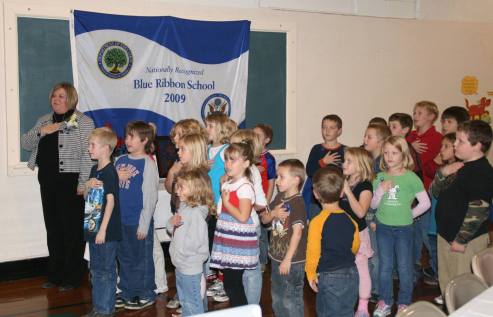
And many people will say Darbi Bauman is the reason behind the success the elementary school has had in recent years.  Most recently, they were named a 2009 No Child Left Behind Blue Ribbon School, one of only 314 elementary schools across the nation who were recognized with this status by the US Department of Education.

Darbi was born November 28, 1963, to Eddie and Rita Hilsabeck. She has three siblings, Kami, Kip and Grady.  She first became a Longhorn in August 1975 when she moved into the district with her family as a sixth grade student. She continued there until she graduated in 1982.  From there, she earned a bachelor of science degree in education in May 1986 from Missouri Western State College and then returned to South Nodaway where she taught both fifth and second grade.

“Darbi and I both started at South Nodaway in the fall of 1986,” Barb Sherry, kindergarten teacher, said. “From the beginning, you could tell that South Nodaway was very dear to her heart. She was always doing special things for her classes.”

Sherry said Darbi was instrumental in pursuing and developing new programs, especially in reading and writing, early in her career.

“She always wanted to motivate and excite her kids about learning,” Sherry said.

One thing her class always looked forward to in the spring was her economics unit, where they ran a pop and popcorn company.

“They learned the basics of starting a business, took a trip to the bank and secured a real loan complete with interest,” Sherry said. “They did cost comparisons, bought the supplies and prepared and sold the product during recess time. Then, with the profit they had earned, they gave back to the community.”

In 1993, Darbi received a master of science degree in education from Northwest Missouri State University. And in 2005, she became the elementary principal.

Macia Kemper, a South Nodaway Board of Education member and parent, said when Darbi was named principal, she was a little disappointed that her two youngest children wouldn’t have the opportunity to have her as a teacher.

“But as the principal, I have watched her turn the whole school into her classroom,” Kemper said. “The kids love her. She creates a loving, nurturing, happy environment.”

Since taking over the helm, Sherry believes Darbi is even more devoted to the school.

“I don’t think a day goes by that she isn’t thinking of what is best for the kids and how she can motivate and inspire them,” she said. “She is truly loved and respected by every single student as well as by her staff and the parents. South Nodaway Elementary is as great as it is in large part because of her.”

Not just a job 

Like all truly exceptional educators, Darbi connects with everyone on a personal level.

“She takes the time to know what’s happening in their lives and what’s important to them, not just on an academic or behavioral level, but on an intimate level,”First Grade Teacher Wanda Bloom said. “The students know she is interested in them as individuals, not just in their academic performance.

“Darbi makes our students feel like they’re among family while at South Nodaway, rather than just students attending school.”

And they reciprocate those feelings toward her. Like the outpouring of love following the recent death of her husband, Kevin, that was shown to her and her children, Taylor, Payden, Quayde and Brody.

“When she returned from work after her husband passed away, every single elementary student greeted her with a hug, one at a time,” Barnard resident and parent, Amy Wolf, said. “The children all love her and so does the community.”

K-12 counselor Nick Wray said he doesn’t know how Darbi handles everything that life throws at her, but she takes it all in stride, displaying quiet strength with each step.

“Those around her become better people just by knowing her and watching the way she copes with the everyday stress that comes along with her profession and her new role as a single parent,” he said.

Her students say it best

For all of the children who have walked the halls at South Nodaway and have known Mrs. B, as they call her, one thing seems to be same. They truly love her.

“Mrs. B is a really nice principal,” Eryn Kemper, second grade, said. “She always gives you hugs and kisses (a supply of candy she keeps in her office). I love Mrs. B.”

Fifth grader Meaghan McConkey said, “Mrs. B is always really happy for us. She likes to hear what we are happy about.”

Kaylin LaMaster, a second grader, said, “She’s nice.”

Thirteen-year-old Shea Miller said, “Mrs. B is the best person I’ve ever met…and I love her to death.”

Quenton Manship, kindergarten, when asked what he thought of her, said, “fine” and nodded his head that he liked her.

Savannah Bennett, a fourth grader, said, “Mrs. B helps us a lot. She’s a great principal.”

Sixth grader Austin Pulley said, “She’s probably one of the best principals in the world.”

Blue Ribbon award

Mrs B

With possibly one of the “best” principals around leading their school, South Nodaway received notification of their Blue Ribbon award back in September.  The program honors public and private schools that are academically superior or demonstrate dramatic gains in student achievement.

Darbi, ever humble, gave the credit to everyone else.

“It is such an honor for this community,” she said. “Our students, faculty, staff, board and parents work hard and it is so nice to see them honored for their dedication.”

When people ask how South Nodaway has achieved so much success, her answer is always the same: “We are about people not programs.”

She continued: “It is all about our students and what is best for them. We have teachers that are committed to helping students reach their potential. We have a veteran staff of professional educators that work tirelessly to meet the individual needs of our students. We are blessed to have a school community that is committed to making the education of our children a priority. What is best for our students drives every decision made.”

South Nodaway Superintendent Kyle Collins said an award like this doesn’t happen overnight.

“It is very gratifying to know that we have such dedicated students who care about doing outstanding work and Mrs. Bauman, the teachers, staff and parents should all be commended for fostering such a positive attitude toward education,” he said. “Darbi brings empathy, compassion and caring to her role as an educational leader. She cares deeply for each of her students and makes decisions based upon what she believes to be best for them.”

Julie McConkey, a parent and math teacher in the district, said Darbi is a very special person.

“The Blue Ribbon is really a reflection of what Darbi and her staff do that is so important to our children,” she said.

And it is by her example, Wray said, they are being recognized.

“The example that she has set for all of us at South Nodaway is one of the main reasons that we are celebrating our designation as a Blue Ribbon School,” he said.

As part of the Blue Ribbon Award, South Nodaway Elementary held a special ceremony at the school on November 13.  Hundreds of students, parents, faculty and community members attended, boasting tiny blue ribbons on their shirts in honor of the award. The entire student body participated, with the fourth to sixth graders singing the national anthem and the kindergarten through third grade leading The Pledge of Allegiance.

Several honored guests were also in attendance, including Larry Price, state supervisor of instruction, Beccy Baldwin, RDPC director, and Sarah Woodward, field representative to Congressman Sam Graves.

“Congratulations to South Nodaway Elementary students, teachers and parents for being named a 2009 Blue Ribbon School,” Woodward said. “Congressman Graves is honored to represent such an exemplary elementary school in Northwest Missouri.”

So even now with the Blue Ribbon Award firmly in hand, Darbi said there will be no backing down or resting.

“We are no different than every other school in Missouri,” she said. “Schools are in the people business where our students all come to us with different backgrounds and experiences. It is our challenge to help them to continue to reach their fullest potential.”

For children like Quentin and Shayna Jo and hundreds of others before them and those yet to come, she is South Nodaway Elementary.

And she is anything but average.

She is the extraordinarily and remarkably uncommon Mrs. B.


First-year football player finds success on the field

The referee’s whistle shrills from down on the field to up in the stands, where a smattering of fans are sitting, mostly parents. It’s definitely hot cocoa, sweatshirt and blanket weather.

“Longhorns are red hot *clap clap*

Longhorns are red hot *clap clap*

Longhorns are R-E-D Red, H-O-T Hot, Red Hot, Red Hot . . .”

The cheerleaders’ chant fades as their shivering takes over and they run to put their heavy jackets back on over their uniforms.

The cloud-streaked sky begins to turn dark and the lights on the field flicker on as the fourth quarter clock begins to tick down. The swift breeze has changed directions now, coming up from the south and swirling around through the wooden stands where the fans have settled back into their seats after stretching.

As the play begins, helmets smack together at the line of scrimmage, and bodies, both tiny and large, are shoved to the left and to the right. The defense is not enough, though, for the home team DeKalb Tigers; forty-five seconds into the final quarter, the South Nodaway junior high football team scores another touchdown against them, putting the Longhorns up 18-6.

On the ensuing kick-off, No. 33 gets a good, solid tackle on the ball carrier.

“Way to go, Scout,” someone yells from the Longhorn section of fans.

Several more minutes pass, and as the clock begins to wind down toward the end of the game, No. 33 still isn’t giving up, even though it looks as though the Maroon and Black have it in the bag.

“Nice work, Scout,” Longhorn Head Coach Aaron Murphy hollers from the sideline. “Keep it up!”

Two plays later, she gets another tackle.

Yes, she.

She is Scout Miller, the 13-year-old eighth grader who is playing in her first year of football for the eight-man junior high team.

After the last tackle, a teammate slaps her shoulder pads in encouragement and her maroon jersey, offset by the black in her helmet, pants, socks and cleats, bobs up and down.

Still playing strong, she lines up in the defensive tackle position, pushes past her opponent on the line and heads straight for the running back carrying the ball. Like a rag doll, she throws him to the ground behind the line of scrimmage, a tackle for a loss of yards.


Taking her own path

On the outside, Scout seems like a typical teenager. The bright-eyed, perpetually-smiling red head has what South Nodaway Elementary Principal Darbi Bauman calls an infectious personality, one who loves to joke around and appreciates a good practical joke.

She is active at school with basketball, track, FCA and FBLA and she enjoys watching TV, especially America’s Best Dance Crew on MTV, reading, art and going fishing. She wants to go to Northwest after she graduates high school and eventually become a teacher, like her favorite, Mrs. Bauman.

And while she seems pretty conventional on the outside, it comes as no surprise to the people who know her, that Scout made an unconventional decision when she chose to play football.

“Scout is the type of student that walks her own path,” Bauman said. “She is not afraid to think outside of the box and that is one quality that makes her so special.”

Most people have been supportive of her decision, including her friends and family, although she said, “my sister, Shea, thought I’d only last a week.”

She obviously proved her sister wrong. And probably a few others along the way.


Learning and progressing

Scout is the daughter of Glenn and Cindy Miller, Barnard, and Annie Thogerson, Arizona, and has seven siblings, mostly older and none who play football. But that didn’t stop her from pursuing her passion.

“I just love football. I wanted to play last year, but my dad was scared I would get hurt,” she said. So when it was time to sign up this year, Scout persisted and was allowed to play.

“I knew the general idea of the game from playing with friends and watching the high school team play,” she said, but also confessed she had a lot to learn about positions and team plays.

A quick learner, Scout’s lack of experience and knowledge didn’t hinder her.

“Scout constantly progressed throughout the season,” Murphy said. “Whenever I would give instruction, she seemed to retain the information quickly and was able to put it into action. The biggest progress she made was on her tackling.”

She wasn’t just improving, she was enjoying it, too, and her practice was paying off. During that game against DeKalb, the final one of the season, Scout recorded six tackles, two of which resulted in a loss of yardage.

Her hard work started long before the season began, though, during summer weightlifting.

“During our summer workouts, Scout worked extremely hard, which I believe pushed the boys to try harder,” Murphy said. “She did anything asked of her to the best of her ability.”


Amazing asset

While being a girl on a boys football team may present itself with some awkward situations, her coaches said the relationships she had with her teammates were very normal.

“Her teammates never hesitated to accept her as a teammate; she was a great contributor and an amazing asset to our team,” Murphy said, who has known Scout and her family for five years. “She is a motivator to the rest of the team, always encouraging and pushing them to do their best.”

As she was supporting her teammates, those around her at school were cheering her on just the same.

“I have never seen or heard any negative comments from anyone about her playing football,” Nick Wray, assistant coach and school counselor, said. “People just want her to play well. They have really supported her decision and rooted for her throughout the season.”

The loudest cheers came on the first game of the year, a 28-8 win against West Nodaway, on a play Scout calls her favorite of the whole season.

“I made a touchdown,” she said. “We were 10 yards away from the goal line and I ran through the four hole and scored.”

The touchdown was one of the best moments of the season, Wray said.

“She just ran into the pile of West Nodaway defenders and carried three of them into the end zone for a touchdown,” he said. “It was one of those moments that gives you goose bumps.”

The season may have been a disappointment for some, with a 2-3 record. But even with the losses, Scout said it was a great experience for her.

“As long as we do our best, it doesn’t matter,” she said.

And as for next year, she is unsure if she will play again. “I want to, but I don’t know,” she said hesitantly, knowing her opponents will most likely be a lot bigger than her.

“It was a true pleasure to have her on the team this year,” Murphy said. “And it was inspiring to see her perform on the field and receive so much success.”


The final seconds

As the horn blared, sounding the end of that game against DeKalb, the South Nodaway fans once again rose to their feet, clapped their hands and cheered for their Longhorns.

In perhaps the last game of her short career, Scout Miller, with her teammates by her side, ran off the field smiling and laughing.

For the 13-year-old, it doesn’t get much better than playing the game she so passionately loves.


Profile of Dr. Vince Bates: brief, stolen moments of attention

Two-year-old Audrey Bates runs across the dining room floor, as fast as her chubby little legs can carry her. As she reaches her daddy’s feet, she jumps up and into his lap, catching him a little off guard.

“Da!” she squeals, shoving a tiny, plastic toy into his long and tired face. “Da!” she yells louder. “Da Da!” The toy is just a means to an end for the adept toddler.

Her father, Dr. Vince Bates, assistant professor of music at Northwest Missouri State University, looks directly into her big, dark eyes, brushes her long bangs out of her face and smiles.

Success. His attention, however brief, was hers.

Content, she scoots down off his lap and runs out of the room.

*****

Like many of his fellow professors, Bates is a busy man. Since joining the staff at Northwest in 2006, he has taught elementary and middle school general music methods, brass methods, French horn, guitar, music appreciation and even freshman seminar. He has presented at various conferences across the country and done research on a variety of topics.

But unlike most of his colleagues, his time is also consumed as the lay minister at his church, The Church of Jesus Christ of Latter-day Saints, which has no full-time professional clergy at the congregational level.

Bates is what is called a branch president, as he presides over the “branch” or congregation of people that are in Nodaway and Atchison counties. The call was extended to him from a stake president, who oversees several congregations in the area.

He has been serving in the position for a year and a half now, a time period that he half-jokingly calls “too long” to a position he did not seek.

“No, this is not something I wanted to do, but we promise to serve where we’re asked to serve,” Bates said. “And I do believe it’s an act of service.”

With the calling, he oversees the work of the members, or Mormons as they are more commonly known, who have responsibilities and who take turns serving in various capacities like Sunday School teacher or youth advisor.

*****

Audrey runs back into the room, jabbering more gibberish about the baby she’s now holding in her hand. She jumps up again into her father’s lap and holds the half-dressed doll for him to see. “Baby, Da Da, baby,” she screeches.

Once more, he affectionately smiles at her. “Yay, baby!” she yells. “Yay!” She’s slides back down, satisfied, off to find her older siblings, Landon (10), William (seven) and Sophie (five).

Born to faithful, hard-working parents, Bates grew up in rural Nevada and Utah, smack dab in the middle of nine children. He learned the value of hard work from living on the farm and a love of music in his humble yet happy home.

“We had a lot of music and we all learned to play the piano to various degrees,” Bates said. “We also used to play together as a family, with dad on accordion, mom on guitar and the rest of us on various band instruments or guitar.

“I was pretty young when I knew I wanted to be a teacher or a musician,” he continued. Watching “The Sound of Music” and listening to his collection of the Statler Brothers, he remembers he had “lots of interest” in the wide variety of music he had experienced as a child.

That exposure included the accordion his father played, an instrument that was taught to him and which he eventually inherited.

“He demonstrated some things for me a few times. Then one day, he was going to show me how to play something and he couldn’t do it. His fingers had gotten so big and stiff from work that he couldn’t push the buttons easily,” Bates said. “He put it down and I don’t ever remember his playing again.”

Bates graduated in 1985 from West Desert High School, in rural western Utah, in a class of two, him and his cousin. He went on to serve a mission for his church from 1986 to 1988 in Denmark to share, he said, what his church believes and where he learned valuable principles that have helped him in the classroom and with the congregation.

“Patience was developed to an extent, although growing up on a farm and working long hours also developed that,” he said. “I think that mainly I learned more about talking to people, being more outgoing and less shy.”

After returning home from Denmark, he continued school and received a bachelor’s degree in music education in 1992 from Brigham Young University and a master’s in music in 1996, also from BYU. Two years later, he married his wife, Kristin, and they welcomed their first child, Landon, the following year.

Prior to Northwest, he taught K-12 music for a total of 12 years in Eureka, Utah. In the middle of his tenure there, he and his family moved to Tucson to work toward a doctorate in music education from the University of Arizona. They lived there from August 1999 to May 2001 and then returned to Utah, where he resumed teaching in Eureka. During his time there, he was able to pass along the knowledge his father gave him of the accordion to one of his students.

Also while in Eureka, the Bates family welcomed two more children, William in 2001 and Sophie in 2004. Audrey was born in 2007, after they had moved to Maryville.

In just the short time he has been at Northwest, Bates has garnered the respect of his colleagues, including Dr. William Richardson, associate professor of music.

“Dr. Bates is an excellent teacher,” Richardson said. “He is always available for Northwest students and graduates who come to him for advice. In the classroom, he is very personable and makes learning fun.”

Bates believes teaching should be student centered, meaning that it should promote student happiness and well being. And it requires physical action.

“It is possible to enjoy something and learn something at the same time. Learning does not have to be stressful to be rigorous,” he said. “Applying principles seems to be valuable to my students. I try to find and think of activities that are engaging and meaningful.”

In addition to his success in the classroom, Richardson said Bates is also well known nationally and internationally as a critical theorist who enjoys questioning established ways of teaching music in public schools.

“This often leads to some amazing outside the box thinking,” Richardson said. “But his research with issues of gender, race and social class in music education is also important and should be heard.”

The more research Bates does, the more he can see the prevalence of these and other forms of discrimination, which he discusses in his music education methods and American popular music classes.

“Class is especially important to me as someone who grew up poor,” he said. “And, whereas it’s not politically correct anymore to be overtly racist or sexist, people still get away with referring to ‘rednecks’ or ‘poor white trash’ and it is still common for people to think that the poor are poor because of things like lower intelligence or laziness.”

In addition to his success in the classroom and his passion for research and theory, Richardson has also noticed Bates’ commitment to his family and his church responsibilities.

“Vince is a very pleasant colleague and friend,” he said. “He and his wife, Kristin, have four wonderful children and are very involved in church activities.”

*****

Sophie begins to sing in the next room, but her song is soon interrupted by her sister’s crying. She tries to get Audrey to color with her. But it’s not the attention Audrey wants.

So Sophie goes back to her singing and coloring. And Audrey goes back to her crying and runs back into the dining room to her father, who swoops her up into his strong but gentle arms.

“Da Da,” she says, as he looks down at her patiently, lovingly. He strokes her light-colored hair and gently bounces her up and down on his knee. Her crying begins to fade into whimpering and continues to diminish until she’s almost completely silent.

Bates is, he said, like his father: quiet.

“He’s quiet and thoughtful,” Dr. Tom Smith, professor of English education at Northwest, said. “When he’s quiet, it’s because he’s listening and thinking.”

Smith serves with Bates at church as his counselor. The two have known each other for a couple of years and spend quite a bit of time together, not just at church, but also with work. They are currently collaborating for a presentation at an education conference in October.

In those two years working together, Smith has seen the compassion Bates has for others, which goes beyond just the physical and temporal needs of the congregation.

“I think being branch president has changed him a lot,” Smith said. “I see him learning to deal with people differently. He’s really concerned about them and making sure they feel welcome and appreciated. He has a vision for the branch and that vision is that everyone is important and everyone matters.”

*****

With several black olives in one hand and her doll in the other, Audrey comes scurrying back and stands at the feet of her father, looking squarely up at him, waiting.

“Baby!” she demands. It’s followed by more unintelligible squeals, commanding more attention from her father.

“The baby won’t eat those olives,” he says matter-of-fact like, keeping a straight face. “They’re dolls. And dolls don’t eat them.”

His joking gets no reaction from Audrey. And the wry look he’s giving her reluctantly turns to a crescent-moon smile and finally to a wide, toothy half-moon grin. As he laughs, she pops one of the olives into her mouth and hurries out of the room again.

Humor is a big part of who he is, although like Audrey, a lot of people don’t always get it.

“He’s actually really funny but you don’t always see it,” Smith said. “It’s a very dry sense of humor.”

Bates said he learned it growing up from his father and grandfather.

“It seems to be pretty common with country folk generally to say something that is really a joke and keep a straight face so that people wonder if you are kidding or not,” he said. “My dad and grandpa were both very good at this.”

It’s sometimes hard, though, to bring that humor to his church calling because it carries with it a good amount of stress and worry. Bates, whose salt and pepper hair has probably gotten a little more salty in the past couple of years, said knowing all about people’s personal problems is difficult for him.

“It’s hard to let it all go,” he said.

And on top of that, it also takes up a significant portion of his free time, time away from his family.

“Family is really important and I feel bad when I don’t spend time with them,” Bates said. “It’s hard to serve the needs of the people in the branch and still have time at home.”

But he also sees his service as a blessing and enjoys helping people with their welfare needs.

“I think we’ve gotten to know a lot more people,” he said. “You get to see them grow and progress. It’s nice to help them with their financial needs – their basic needs – and have the resources to help. And it’s given us more perspective.”

His wife, Kristin, agrees there are blessings that come with it and she’s grateful for the time they have to learn and grow through this experience.

“It’s helped us to all have more focus on helping others…and it makes us more appreciative of the blessings we have,” she said. “The calling doesn’t last forever, and when he’s released, I know he wants to feel that he did all he could do and worked hard at it.”

*****

Audrey’s made her way back into the dining room, wearing part of the dinner Kristin is making on her face.

First, she asks: “Me?”

Nothing. She presses harder. “Me! Me!”

Still nothing, so she smiles. “Me, Da Da, Me.”

He smiles, too, reaches down and picks her up.

With the busy schedule he carries as professor and branch president – and as husband and father – those brief, stolen moments of his attention are cherished.

And for Audrey, who has now traded in the doll for the earlier plastic toy, she’s happy just the same. She’s got her Da.