‘The appalling silence of the good people’

“That they might have joy” column written for the Nodaway News Leader, January 2014

In December of 2012, our family traveled to Washington, DC, for Christmas. We had just been there that summer, but like most any trip, we didn’t get to see as many things as we would’ve liked.

We had visited the National Mall during the summer, but with our frantic pace to “see everything,” we somehow missed the Martin Luther King, Jr. Memorial. So it was at the top of my list.
408455_10151409856302674_677284976_n

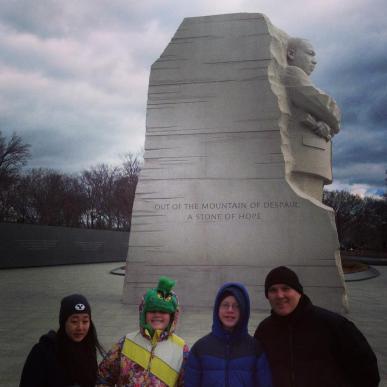
December 2012 trip to DC … at the Martin Luther King, Jr. Memorial with our exchange student, Yuki, Hannah, Hunter and Larry.

It’s a relatively new memorial, dedicated in 2011, and contains the Mountain of Despair and the Stone of Hope that also has a sculpture of Dr. King. There are 14 of his quotes engraved on the wall surrounding it including a couple of my favorites:

Injustice anywhere is a threat to justice everywhere. We are caught in an inescapable network of mutuality, tied in a single garment of destiny. Whatever affects one directly, affects all indirectly.

The ultimate measure of a man is not where he stands in moments of comfort and convenience, but where he stands at times of challenge and controversy. The true neighbor will risk his position, his prestige, and even his life for the welfare of others.

Like much of what I saw in DC, the memorial moved me. But there, with the inspiring words of Dr. King surrounding his statue, I was also filled with hope. And also with anger.

Sharing this family road trip experience is timely, with King’s birthday on the 15th and the national observance on the 20th.

But the real reason is that the injustices he fought for and ultimately died for 50 years ago are still an issue today.

To think otherwise is ignorant. And to simply place the blame on the past is appalling.

This past month, Jamelle Bouie, writer for The Daily Beast, wrote: “Just because we don’t face the racism of the past doesn’t mean we’ve solved the problem. We haven’t.”

And in November, writing for The Nation, Mychal Denzel Smith said: “It sounds harsh, but I truly believe ‘Are things better?’ is one of the most useless questions in a discussion about racism. By reframing the conversation around how much progress has been made, we further the false narrative that racism is a problem that belongs to history. While we pat ourselves on the back for not being as horrible as we once were, we allow racism to become further entrenched in every aspect of American life.”

A 2013 Pew Research poll revealed there is still a “persistent belief that discrimination and unfairness remain a part of life for African Americans in this country” and 88 percent said they believed there was either a lot or some discrimination against blacks.

Just last week in The Guardian, Chris Arnade wrote: “We as a nation applaud ourselves for having moved beyond race. We find one or two self-made blacks or Hispanics who succeeded against terrible odds, and we elevate their stories to a higher position…. We tell their stories so we can forget about the others, the ones who couldn’t overcome the long odds, the ones born into neighborhoods locked down by the absurd war on drugs, the ones born with almost even odds that their fathers will at some point be in jail, the ones born into neighborhoods that few want to teach in, neighborhoods scarce of resources. Gone is the overt, violent and legal racism of my childhood. It has been replaced by a subtler version. It is a racism that is easier to ignore, easier to deny and consequently almost as dangerous.”

What’s more is that we think it’s only bad people treating others badly.

In March of last year, Ta-Nehisi Coats wrote in the New York Times: “In modern America we believe racism to be the property of the uniquely villainous and morally deformed, the ideology of trolls, gorgons and orcs. We believe this even when we are actually being racist. The idea that racism lives in the heart of particularly evil individuals, as opposed to the heart of a democratic society, is reinforcing to anyone who might, from time to time, find their tongue sprinting ahead of their discretion.”

We can no longer blame it on the evil generations of the past. It’s you and it’s me. It’s relatively good people being extraordinarily ignorant.

So stop. Stop being ignorant. Stop the knee-jerk reactions when we see something or someone and judge them. Recognize it and stop it. Let’s educate ourselves and move forward, beyond ignorance.

And then, have the courage to take a stand, to speak up during “times of challenge and controversy,” or even in times of quiet, when we’re alone with someone we know who is speaking words of hate, maybe not even consciously. Have the courage to no longer be silent.

History will have to record that the greatest tragedy of this period of social transition was not the strident clamor of the bad people, but the appalling silence of the good people.

The appalling silence of the good people. Let’s not let that be us.


Hounds defeat Oak Grove to advance to semifinal game

By Jacki Wood, Nodaway News Leader, November 2013

And then there were four.

The Maryville Spoofhounds took one step closer to a return to the Dome on November 16.

The Hounds’ 42-20 win at Oak Grove in the state quarterfinal game makes them one of four teams left in the Class 3 playoffs.

But Head Coach Matt Webb isn’t letting his team get ahead of themselves.

“We talk about one day at a time,” Webb said. “Win the day.”

It’s been a phrase he’s used since the beginning of last year when the Hounds began the historic ride they are currently on – a 28-game winning streak.

And it’s the phrase he’ll continue to use as they head into this weekend’s semifinal game against 12-1 California, a rematch of last year’s semifinal game against the Pintos in which Maryville won 42-7.

“California is a great football team,” Webb said. “We feel like this was a great team we just beat and we know California is going to be just as good.”

Not only did Maryville beat a solid Oak Grove team Saturday, they also did it battling against the wind, which had gusts of 30-40 mph.

The Hounds started the game facing that wind but seemed undeterred by it. After a 53-yard run by junior Brody McMahon, senior quarterback Trent Nally scored on a one-yard keeper to go up 6-0 with 10:54 to go in the first.

Oak Grove responded with a touchdown of its own, but the Hounds blocked the PAT to keep it tied at 6-6 with 5:18 remaining.

On the next drive, Nally fumbled the snap and the Panthers took over at the Maryville 24-yard line. But Oak Grove wasn’t able to capitalize on the turnover and the quarter ended still tied, 6-6.

The Hounds used a big second quarter with the wind at their backs to tack on two touchdowns – a 42-yard pass from Nally to Payden Dawson and a two-yard run by McMahon. The defense also came up big, holding Oak Grove scoreless, to take a 22-6 lead into halftime.

“We were able to score twice with the wind in the second quarter,” Webb said. “And that was huge.”

Oak Grove scored first in the third quarter, but Maryville quickly responded with a 32-yard Nally-to-McMahon TD to make it 28-14 with 7:04 left in the third.

The Panthers and Hounds traded touchdowns once again. Oak Grove scored with 4:21 left to make it a 28-10 game. Then with just over a minute to go, Nally found the end zone from 13 yards out, and a two-point conversion by McMahon put Maryville up 36-20.

Maryville’s defense responded again in the fourth quarter. With 7:13 left in the game, the Hounds held Oak Grove on 4th and 13 to regain possession. The offense put together a long drive and Nally added his fifth score of the game. His one-yard rushing touchdown put the Hounds up 42-20 with 2:53 remaining, which would hold as the final score.

“That was two very good football teams, laying it on the line,” Webb said. “That’s what playoff football is. I’m just very proud of the character and effort of our young men.”

Nally was 5-6 passing for 137 yards and two TDs. He also had 11 rushes for 45 yards and three TDs.

McMahon carried the ball 17 times for 136 yards and one touchdown. Dakota Beemer had 10 rushes for 64 yards and Dawson added six rushes for 20 yards.

Adam Thompson had two receptions for 43 yards, Dawson had one catch for 42 yards and a touchdown, McMahon had one catch for 32 yards and a touchdown and Beemer had one reception for 20 yards.

Chris Dougan led the defense with 13.5 tackles. Nally and Elijah Green each had 9.5 tackles, followed by John Schenkel with 6.5 and Dawson and McMahon with five each. Dalton Pistole added 3.5 tackles, Adam Thompson had three, Jackson Morrison had 2.5 and Brendan Weybrew added two.

With the win, the Hounds advance to the state semifinal game at California on Saturday, November 23. Kickoff is set for 1:30 pm.


The Next Generation – Gregory family continues tradition

By Jacki Wood for The Herald, Sweet Springs, MO

photo 1

Three-year-old Reagan Sneed skips about the family farm, kicking up dust with ease in the unusually dry mid-September afternoon air.

Happy and carefree, she sings as she skips, trying to entice Amber, the weeks-old bottle calf, to follow her lead. Reagan grabs the calf by the neck and kisses her.

“Amber is my friend,” Reagan says. “I help feed a bottle. And I sing to her.

“She runs and jumps. And sometimes she gets frisky.”

The bond between a girl and her calf has formed.

And so it begins with Reagan. Another generation. The fifth generation, actually, of Gregory Polled Herefords.

***

photo 2

E.H. Gregory started the family business in 1932 in Green Ridge and later moved to the Houstonia area.

His son, J.D., carried on the tradition and passed it on to his son, Kevin, who continues the family business today.

photo 3

Kevin and his wife, Barb, have four daughters – Jennifer, 33, Devann, 21, Morgann, 19, and Jordann, 18. Jennifer and her husband, Brian Sneed, are the parents to Reagan and her one-year-old brother, Rhett.

All live within a mile of the family farm. And all of the girls began showing cattle at the same age as Reagan is now.

It’s their legacy, Barb says.

“It’s our family heritage,” she said. “It’s what they love, what they’ll do forever, what they’ll pass down to their kids.”

 ***

Showing cattle takes dedication and responsibility. The process begins in December when they choose their animals and begin breaking them. It continues through the end of the summer with local shows, the Missouri State Fair and the Junior National Show.

Kids can begin showing at age three with bottle calves for local shows and the junior nationals are for youth ages 8-22.

It means no days off. No snow days. Early mornings and late nights. Taking care of the cattle on those unbearably hot summer days in the humidity Missouri is known for as well as the bitter cold, snow and ice that wintertime can bring.

“It’s just a lot of hands on,” Kevin said.

They walk, wash and work them every day, spending an hour or even two or three with them, depending on the time of year.

“The more you get your hands on the animal, the better they will act,” Devann said.

After months of preparation and hours of work, taking their cattle to the shows can lead to mixed feelings. Some of the cattle they are excited to sell and some they have become very attached to and are hard to see go.

“They are like your children and it’s very hard to get rid of them,” Jordann said.
“I cry every year no matter how old I am.”

***

As the years pass, the Gregory name has become synonymous with success. And at cattle shows, that means bringing home the Grand Champion purple banner.

“We’ve done pretty well,” Kevin said. “We’ve all, at some point, brought the purple banner home. And we have sold animals that we have raised that have done the same thing.”

While the successes have been many, there are a few that were especially significant to each of them.

In 2006, Jordann won Grand Champion Hereford Steer at the State Fair, her first year showing steers there.

Last year, Devann pulled a little heifer out of the pasture a couple of weeks before a show, not expecting her to do well. But she was named Champion Division Winner in both the FFA and the open show.

This summer, Morgann won Grand Champion Bred and Owned Heifer at the Pettis County Livestock Show.

Sometimes, though, it’s not the cattle being shown, but the cattle they’ve sold. In 1999 while attending the National Western Stock Show in Denver, they came across a calf that Kevin had sold who had won Reserve Division Champion.

But it’s not just about the champions or the results.

It’s also about the process, traveling together, meeting people and having fun together.

“Going to different shows, like our junior nationals,” Morgann said, “you get to meet and make friends from all over the United States that you wouldn’t necessarily have the opportunity to meet outside of showing cattle.”

They form friendships that last over the years. And when they are at a show, Kevin will invariably run into someone he knew growing up.

“We’ve been in long enough that kids I showed with 25-30 years ago, now their kids are showing,” he said.

***

Barb grew up in Kansas City and married into this but she seems to be the glue that holds it all together.

The girls said she helps wash the animals, helps walk them and she makes sure they get where they need to be with everything they need – and on time.

When it comes down to it, it’s really all about family.

“It’s something you can do with your whole family,”Barb said.

photo 4

From J.D. at 80 years of age down to Reagan at three years, they are all involved and love it.

Kevin said his father still goes to all of the shows.

“Wherever the kids are, he’s there ready to help,” he said. “With Reagan and the bottle calf, he makes sure he’s got her bottle ready to go and he goes out there with her. It’s neat to see him with her.”And it would seem the Gregory legacy will continue for years to come.


Concordia’s comeback falls short

By Jacki Wood, Sports Editor, written for The Concordian

After a turnover-laden first half, the Concordia Orioles turned things around in Friday’s home opener against the Higginsville Huskers. But it wasn’t quite enough as the Orioles lost 42-26.

“Turnovers in the first half dug a hole that was difficult to overcome,” Concordia head coach Tom Gramates said. “We went into a funk in the first quarter. But we were able to pull ourselves out of it.”

Concordia turned the ball over four times in the half – two fumbles and an interception in the first quarter and another interception in the second quarter – and Higginsville capitalized, scoring after each one.

The Class 2 Huskers entered the game after going undefeated during the regular season last year with a nice playoff run.

“We knew that Higginsville was a quality team and we had our hands full,” Gramates said. “Yet I believe, and our players believe, we could have won the game had we taken care of the little things.”

With three minutes left in the first quarter and the Huskers leading 20-0, Concordia put together a solid drive down to the 17-yard line to end the quarter. Continuing that drive as the second started, quarterback Austin Hon ran it in for the Orioles’ first TD of the game. Cass Heimsoth completed the two-point conversion to make it a 20-8 game with 10:34 left in the half.

The Huskers responded quickly to go up 28-8 where the score remained at halftime.

A couple of turnovers by both teams to start the third quarter made it seem as though the turnovers would be the story of the night.

But the Orioles had other things in mind.

Late in the third, Heimsoth and Cory Meineka put together several long runs down to the Husker seven-yard line. Meineka scored on a shovel pass from Hon to bring the score to 28-14 with three minutes left.

And after a strong defensive stand and a muffed punt recovered by the Orioles, the momentum quickly moved into Concordia’s favor.

With 19.6 seconds left in the third, a 32-yard touchdown pass to Beydler made it a 28-20 game.

Continuing their comeback, Concordia recovered a fumbled kickoff, and on the first play of the fourth quarter, they scored again on a 30-yard pass from Hon to Beydler, making it a 28-26 game with 11:53 left in the game.

“It was a fun game with a lot of emotion and heroic play by our guys,” Gramates said. “It was kind of like riding the back roads on an eighth of a tank of gas. You know you’re going to run out and eventually end up walking.”

Down by two, the Orioles weren’t quite ready to get out and walk home just yet.

They caused another fumble on the kickoff and recovered it to take over at the Huskers’ 48-yard line at the 11:51 mark.

But on the first pass of the drive, Higginsville intercepted a pass by Hon. And after a couple of big defensive stops by both teams, the Huskers scored with 7:09 to go to make it 35-26.

Higginsville began running the ball well – and the clock out – late in the fourth. They scored one final time with 1:22 left, ending Concordia’s comeback and the game, with a final score of 42-26.

“This group will improve, no doubt about it,” Gramates said. “The character they displayed Friday night was exceptional. I was really excited to see the emotion we played with (and) the attitude of playing together.”

Gramates said Higginsville made a point of taking Heimsoth out of the passing game, which allowed other receivers to have good games.

“We found a couple of really good players that were question marks,” he said. “Austin Beydler was a great compliment to Cass Heimsoth on the other side. He had an outstanding game. Jordan Schuelter also came up big with some key catches.”

With quality receivers and a solid quarterback, Gramates said they have a more diverse threat than last year.

“I don’t know the last time a Concordia team threw the ball for 277 yards in a competitive game,” he said. “It showed us a lot.”

Gramates said the Orioles started five linemen that had not played “a meaningful down in varsity football,” and while they made mistakes, he said he believes they will get better.

He was also impressed by the defensive play of Meineka and Layne Baldwin.

“They are the heart and soul of the defense right now,” he said.

The extreme heat, which caused the game to be pushed back an hour, also caused some issues with cramping. The Orioles also suffered a couple of injuries including Andy Galloway, the team’s kicker.

“Had we been able to kick the PATs in the second half,” Gramates said, “we would have taken the lead in the fourth quarter.”

Hon finished the game 15-34 passing for 245 yards, a touchdown and four interceptions. Beydler had seven receptions for 128 yards. Meineka had 14 carries for 75 yards and Heimsoth had six carries for 48 yards.

Baldwin led the team in tackles with eight solo, one assisted and three tackles for loss. Hon has six solo and two assisted, Meineka had three solo, three assisted, one tackle for loss and one sack and Patrick Hastings had three solo, one assisted, two tackles for loss, a sack and a forced fumble.

The Orioles are back in action this Friday at home against Orrick.


Fall 2013 Sports Preview

I just finished my first high school sports preview. It features the I-70 Conference football and volleyball teams. In addition to writing all of the stories, I also did the design…my first time doing an entire section. I have a greater appreciation for those who’ve gone before me. Lots of work. But so much fun.


‘Parting is such sweet sorrow’

“That they might have joy column” by Jacki Wood

In “Ulysses,” Alfred, Lord Tennyson wrote:

“I cannot rest from travel…

“Much have I seen and known; cities of men

“And manners, climates, councils, governments…

“I am a part of all that I have met.”

This is one of my favorite passages ever written, because like Tennyson, I feel I am a part of all I have met.

I’d like to rewind the clock back to August 2006 when I first started here at the Nodaway News Leader and share a little about those I’ve met…

My first feature story came a couple of months into the job: “Graham Lions Club marks 50 years of frying fish.” I will never forget all of those men working in the kitchen, frying chicken and fish. And the stories they told. And how I felt welcomed there. There’s something special about a small town and its people.

A little over a year later, the December 2007 ice storm hit. I slid all over town, taking photos of the damage and of people helping one another. I also spent some time at the Red Cross shelter at the Maryville Community Center. I met a lot of amazing people and I wrote about a woman I met named Grace: “She helped care for an elderly woman from her community, something I learned she does on a daily basis, and being at the shelter was no different. In the quiet moments, when no one was aware, I saw her for who she really was. A strong-willed woman, she had a coarse voice, and yet she was so full of patience and love for her friend. I will forever be changed because of Grace.”

In the fall of 2009, South Nodaway Elementary was recognized as a National Blue Ribbon School for academic achievement. Since I covered the district, I attended a special community ceremony, but I also had this crazy idea to do a feature story on the principal, Darbi Bauman, since I had come to learn that Mrs. B, as she is known by her students, was the heart of that school.

I knew, though, that the humble principal would never agree to it, so I did it in secret. Everyone had an amazing story about Mrs. B. And everyone wanted to be involved — current students, former students, her staff, community members. The result was “Behind the blue ribbon lies the extraordinary, remarkably uncommon… Mrs. B.”

Darbi told me earlier this month she still hadn’t forgiven me. It’s a story I will never forget. And she is someone who I now call a friend.

In December 2010, I spoke to some local high school students for Issues and Answers where I asked them about their goals for the new year. Their responses were typical teenage goals like getting their driver’s licenses or doing well in sports. One girl, however, looked at me, smiled casually and said, “Enjoy it.”

I loved it. And I wrote a column about finding joy in the journey because of her. I don’t remember her name but I will never forget her simple yet wise statement.

During the summer of 2011, I did a couple of “a day in the life” stories. I met dairy farmer, Richard Groves, who has lived on the same land his entire life near Graham. He taught me a lot that day, not just about cows and milk, but about doing what you love. He said, “It’s a hard life, but it’s a good life.” We sometimes get overwhelmed with how hard life can be that we forget how blessed we truly are.

A couple of months later, I covered the fire at the Third and Main building in downtown Maryville. I later wrote about an experience I had during those early morning hours:

“I walked out of the Nodaway News Leader office just as the morning light showed the harsh reality of the downtown fire earlier this month. I’d already been out to take pictures when it was still dark, so I was heading out to take a few more when I saw a weary Dave Weigel walking toward me. His business had been completely destroyed. And typical Dave, he seemed almost upbeat about forging ahead.”

I’ve seen that same resiliency and optimism in many I’ve met in Nodaway County.

Last summer, I wrote a “fun and games” series and had the privilege of interviewing several of my former teachers for this story: “Bridge Club builds relationships for over 40 years.” I spent an hour listening to them laugh as they shared stories. One from their group, Marj Hansen, died last week, too young, from cancer. The community will miss her greatly.

Earlier this year, I was tasked with sharing the most difficult story I’ve ever had to write. It was a story about hospice called “Refracted: seeing life in a different light.”

“His spirit is willing but his body is weak. Diagnosed with inoperable pancreatic cancer in August, Maryville resident Gus Rischer was told he had up to six months to live. ‘I’m getting near the end of my road,’ the soft-spoken 83-year-old said.”

Gus has since passed, but his story taught me so much about living life and facing death with grace.

There are hundreds more stories like these. Hundreds more I’ve met, or previous relationships I’ve renewed, who have become a part of me.

I’m a part of school administrators, teachers, secretaries and students; a part of city leaders and business owners; a part of organization volunteers and community leaders.

I am a part of Nodaway County.

And now, well, now the time has come. The time to bid farewell. This is my last week with the paper.

As Shakespeare said in Romeo and Juliet, “Parting is such sweet sorrow.”

I am sad to be leaving. It’s been an incredible seven years here. However, all things must end. And so it is with my time here.

Thank you all for helping me over the years, for teaching me and helping me to grow.

I am indeed a part of all that I have met.


An honest conversation about obesity

“That they might have joy” column by Jacki Wood

I have fibromyalgia. It’s a big word for a syndrome that basically means I’ve been in pain every day since 1996.

Some days have been tolerable, some rough and some downright unbearable.

It’s also basically how I became obese. Well, sort of.

But I’m getting ahead of myself…

I was very active growing up. I loved playing everything from soccer and softball to basketball and football. It’s also how I dealt with life’s stresses. This continued when I went to college. If I had a problem, I went out and played ball until I felt better.

During my junior year at BYU, I was probably the most active and fit I’d ever been in my life. And then one day, I woke up and I hurt everywhere. That was 1996.

Time passed. I was diagnosed. I dealt with it. Sometimes with success. Sometimes not so much.

It was several years later and dealing with a family member’s health issue that finally sent me over the edge… to self-medication. Not with alcohol or drugs. But with food.

I no longer could deal with stress by playing basketball. And so I turned to food.

I’m not going to go into all of the details, but my lifestyle had become mainly sedentary due to the pain of fibromyalgia. And that collided with my newfound solace in bad food – and a lot of it.

That was around 2001. The self-medicating continued for several years while I started packing on the pounds.

I tried a couple of times to lose weight, and had some success, but it wasn’t sustainable and I fell back into old habits.

Then in December of 2011, a friend of mine asked if I was interested in participating with her in the New Year’s Challenge at the Maryville Community Center. At first, I really only agreed so I’d be able to see her more often on my weekly trips to Maryville for work.

Then that Christmas, we traveled to Florida to see family and take our kids to The Wizarding World of Harry Potter. It was a great trip. But it was also life-changing for me.

The day we went to the park, we headed straight for the Harry Potter and the Forbidden Journey ride. Everyone was excited. But as we approached the castle, my excitement turned into terror. I noticed one of those seats at the beginning of the line; you know, the ones to see if you’re too fat to fit on the ride.

I was horrified. I hadn’t been on a roller coaster in several years and wondered if I was now too fat to ride one. Well, I wasn’t, but it was a very uncomfortable situation, both literally and figuratively.

That experience probably could’ve been enough for me to want to change. But there was more.

The following day, my husband took a picture of me sitting next to his nephew’s wife. When he showed it to me, I was clearly more than twice her size. Now, in my defense, she maybe weighs a hundred pounds soaking wet. But the photo spoke volumes to me.

I was obese, plain and simple.

It was a fact I already knew. But seeing it in the photo – combined with the amusement park ride the day before – struck something new deep down inside of me.

I had to make some real changes.

And so I did. Since I had already signed up for the New Year’s Challenge, I now had the commitment and accountability to help.

Image

So why am I talking about this now, a year and a half later? Well, there are a lot of reasons.

First of all, I think it’s a conversation that needs to take place. It’s a serious health concern that many of us would rather just avoid talking about, one I avoided for many years.

Secondly, I think we all need to do a lot less judging and have more understanding for others. It’s not like one day I woke up and said I think I want to eat unhealthy amounts of bad food and become obese. Did I make mistakes? Yes. A lot of them. But there were also underlying issues that led me down that path.

Lastly, it’s hard to lose weight, especially when you’re also battling another illness. Indescribably hard. But it is possible. And we need to help encourage others.

Since January of 2012, I’ve lost 80 pounds with another 20 to go to reach my goal. It’s a constant battle. Sometimes two steps forward and one back. Sometimes two or three back.

People ask me how I’ve done it but I’ve found there’s not an easy answer for that. Each journey is different because each person and circumstance is different. Because of my fibromyalgia pain, I did it mainly through changing the way I eat.

I’m not telling you my story for recognition. I’m sharing it to hopefully offer a little encouragement. It’s a story I was scared to tell but one I think is more important than my pride or my embarrassment.

Brené Brown said: “Owning our story and loving ourselves through that process is the bravest thing that we’ll ever do.”

It has been for me. And I believe it can be for you, too.


Play Ball! Father passes his love of the game on to his son

By Jacki Wood for the Nodaway News Leader
Editor’s note: this is the fourth in the series

LyleBoys

Albert Theodore Powers said: “Baseball is sunshine, green grass, fathers and sons, our rural past.”

That’s what Maryville resident Jeff Lyle loves about the game.

“It brings me back to my roots,” he said.

The 42-year-old has been a fan of the game all of his life and a fan of the Kansas City Royals ever since going to Kauffman Stadium as a little boy with his grandpa.

“This is where my love of the game comes from,” he said. “I love baseball because it’s a wholesome sport that brings me back to my childhood, simpler times and just good old fashion fun.”

And now he’s passing that love onto his son, Trystan, who attends all of the Royals’ games with him.

Lyle also coaches Trystan’s team during the summer.

“Watching my soon-to-be 15-year-old son play short stop is one of my favorite things to do in the world,” he said. “I’ve given up Royals front-row seats to watch my son play a pick-up game on a Saturday afternoon.”

In addition to watching his son and the Royals play, Lyle also enjoys learning about the history of his favorite team. He and Trystan frequently tour the Royals Hall of Fame at Kauffman Stadium.

“Kauffman is good about keeping the Hall of Fame fresh by adding new things,” he said.

He’s also been to the Missouri Sports Hall of Fame in Springfield and would love to see more of those types of venues, he said.

Last year, he had the opportunity of taking in the All-Star Fan Fest when the All-Star game was in Kansas City.

“It was amazing,” he said. “I felt like a little kid in a candy store.”

Over the years, he’s also compiled quite a baseball collection.

“My wife calls it my addition, not collection,” he said. “I own all the Kauffman Stadium giveaway Bobbleheads, which are also on display in the Hall of Fame.”
He has also renovated an entire room in his home just for his Royals collection which includes both vintage and new items, jerseys, toys, coolers, All-Star merchandise, broken game bats and “too much more to mention,” he said.

“It’s quite overwhelming and very impressive,” he continued. “I’ve spent a lot of time and money collecting it and finding just that right item here and there.”

Other fun baseball fan facts about Lyle include his favorite ballpark is Kauffman Stadium since that’s where the Royals play, his favorite ballpark food is a stadium hot dog and “The Bad News Bears” with Walter Matthau is his favorite baseball movie.

For Lyle, what baseball really means is wholesome fun with family and friends, he said, especially with Trystan.

“I’m so glad I’ve been given the opportunity to share my love of baseball with my son,” he said.

“Keeping the sport alive is up to the fans. I’ve got my part covered.”


Road tripping with the 100 Missouri Miles challenge

Wandering Alongside the Woods column by Jacki Wood

Summer + The Great Outdoors + Road Trips = Missouri.

Missouri?

Yes, our beautiful backyard that is the Show-Me State.

I’ve brought back my road trip column with a challenge for you to kick off the summer fun. Or, rather, Gov. Nixon has. And I think it’s a really great idea.

Earlier this year, Missouri was honored by being named the Best Trails State in the country, which led the governor to launch the “100 Missouri Miles” initiative recently. It challenges Missourians to complete 100 miles of outdoor physical activity by the end of the year.

“Whether you run, walk, bike, paddle or roll, everyone can participate,” Nixon said. “This initiative is a great opportunity to promote Missouri’s proud outdoor heritage, improve your health and — best of all — have fun with family and friends.”

While the idea is to get active and see more of outdoor Missouri, I think it’s also a good excuse to road trip. Our family has taken the challenge and I’m excited to explore the many places and events in the state that we have yet to discover.

In addition to getting your 100 miles in, I suggest doing and seeing a little more. Visit a museum or historical site, eat local food, go shopping and attend special events.

One place I’m looking forward to returning to and seeing more of is Hannibal, boyhood home of Mark Twain. We took our kids there for the first time six years ago.

There’s tons to see and do — museums, the riverboat on the Mississippi River, a cave and Mark Twain State Park, which includes hiking trails and a lake.

Make sure you stop at the Mark Twain Family Restaurant, Hannibal’s hometown restaurant since 1942, where we enjoyed the famous frosty mugs of homemade root beer, onion rings served by the foot and Mississippi mud malts.

The historic community also boasts a ton of events, music and festivals throughout the summertime. Visit visithannibal.com for more information.

Other places on my list of 100 Missouri Miles road trips this year include:

Bothwell Lodge State Historic Site near Sedalia. Built atop a bluff and two natural caves, the 20th Century lodge has 31 rooms and original furnishings as well as hiking and biking trails. In addition, the historic site is hosting “Cameras at the Castle Photo Contest” which is free and open to the public and runs through October 1.

Ha Ha Tonka State Park near Lake of the Ozarks. Highlights of the park include the stone ruins of a turn-of-the-20th-century castle, a lake, caves, natural bridges and trails.

Cuivre River State Park in northeast Missouri. Miles of hiking trails curving through tall prairie grasses, woodlands and Big Sugar Creek are featured in this park as well as fishing and camping.

Johnson’s Shut-Ins State Park in southeastern Missouri. The park has a little something for everyone — camping, fishing, swimming, rock climbing, mountain biking and hiking through 1.4 billion years of geologic history.

Iliniwek Village State Historical Site in northeast Missouri. This area was once home to an Illinois Indian village when Louis Jolliet and Jacques Marquette came through in 1673. The trails provide information about the village’s inhabitants.

Elephant Rocks State Park in southeast Missouri. Named after the giant elephant-shaped granite boulders, the park includes a trail that winds through the rocks and picnic areas.

There are also some great shorter road trip or day trip destinations closer to home like Crowder State Park near Trenton or Watkins Mill State Park and Historic Site near Lawson, both of which are beautiful.

And if you’re just trying to get your 100 Missouri Miles in, Nodaway County’s own Mozingo Lake has great trails and the Missouri Department of Conservation has several natural areas throughout the state which are also great for hiking and exploring.

To sign up for the 100 Missouri Miles initiative, visit 100MissouriMiles.com. You can also check out other places to explore at mostateparks.com or mdc.mo.gov.

Happy road tripping.


Refracted: seeing life in a different light

 His spirit is willing but his body is weak.

Diagnosed with inoperable pancreatic cancer in August, Maryville resident Gus Rischer was told he had up to six months to live.

“I’m getting near the end of my road,” the soft-spoken 83-year-old said.

While his body has been failing him the last few months, his mind tells a different tale… still razor sharp as he shares his story… about his family, coming to Maryville, his stained-glass hobby and his decision to choose hospice care.

***

Originally from St. Louis, Rischer attended Pepperdine University and California State University, Los Angeles, for undergraduate and graduate degrees before returning to Missouri. In 1968, he began his tenure at Northwest Missouri State University where he was a psychology professor and chairman of the department for eight years before retiring in 1991.

He and his late wife, Katie, have three sons, Brad, Jon and Greg, and three grandchildren.

***

Rischer has been down the brutal and unforgiving cancer road before with his wife. So it was an easy decision to not have any of what he called “false kinds” of treatment like chemotherapy or radiation after his diagnosis.

“I watched my wife die with that,” he said. “It was a miserable process with her and I didn’t particularly look forward to experiencing it.”

He looked at what options were available and chose hospice care through SSM Hospice of Northwest Missouri in Maryville.

“I decided to take it as it comes and live in my own home until I can’t do it anymore,” he said.

***

In the last several months, the care given through hospice staff members has helped Rischer and his family deal with the reality of the prognosis.

It has also enabled him the time at home to go through his remaining stained-glass treasures, hundreds of pieces he’s crafted over the last 13 years, and give them to his children and grandchildren.

Frogs and teddy bears. Window hangings for the holidays. A slew of picture frames. And his personal favorites — two complete sets of ducks.

“I really enjoyed making the ducks,” he said. “I had spent hours and hours making them for myself.”

One set has now gone to his son, Brad, and the other will go to his son, Jon.

***

Walking around his home, showing off that set of stained-glass ducks which Jon hasn’t received yet, Rischer’s step is noticeably slower. And his voice a little more weathered. But brief moments of joy flash across his face as he describes in detail his love of the hobby.

It began when a friend of his was visiting Maryville.

“He was making figurines to hang in windows,” Rischer said. “So I asked him if he could teach me. Before he left, he had taught me how to cut glass, how to weld it and how to put it in a frame.”

***

Rischer completed his very first project, a stained glass window for his bathroom, on his friend’s next visit to town.
 Since that time, he said he’s made three to four hundred items, at least, which he’s given away.

“It was fun to learn and to watch myself progress and get better,” he said. “And then to see other people enjoy it.”

But because of the pain from pancreatic cancer over the last few months, his abilities have declined.

***

The hospice care staff has been wonderful in many ways, Rischer said, especially in helping him manage the pain.

“They’re a special kind of people,” he said.

One aspect he has especially enjoyed has been the time spent visiting with a pastor.

“I’m not a very religious person but the pastor who comes to visit, I enjoy his visits,” he said. “He’s a very intelligent man and we just talk, not necessarily anything religious. Maybe about something in the news. We enjoy each other’s viewpoints on daily happenings.”

***

Looking out Rischer’s front room window, the view unfolds the rolling hills and fields that are so characteristic of the Midwest landscape. The setting sun just above the horizon streams light into his stained-glass window.

The process of the artistry that went into that first project — and all of them since then — begins with picking out 12×12- or 12×14-inch pieces of glass.

After gluing a pattern of what he wants to make onto the glass, it is cut with a special glass cutter and the edges are smoothed with a grinder.

The pattern is then removed and copper foil is wrapped around all of the pieces which are put together like a puzzle, he said, one against the other so the soldering can begin.

When each of the pieces has been soldered on both sides of the glass, the project is finished by being cleaned and waxed.

“It’s an interesting, lengthy, multi-skilled process,” he said.

***

Rischer’s hospice care could also be described as a multi-skilled process. In addition to the pastor who visits an hour each week, he also has a social worker, physical therapist and a nurse who comes to his home every three days or whenever he needs more attention.

“Hospice is a wonderful organization,” he said. “And the one we have in Maryville is an award-winning organization.”

***

While Rischer saw his stained-glass artwork as simply a hobby, after many hours of practice, he’s been able to produce many beautiful and wonderful pieces.

To be truly enjoyed, stained glass depends on refracted light. Only after light passes through the glass can the beauty and wonder be seen.

Refraction is defined as a change in direction because of a change in the medium. It can also be defined as altering something by viewing it differently.

With stained glass, it is the turning or bending of the light when it passes through the colored pieces at different angles.

With Rischer, it has been the opportunity to see life in a different light through his hospice care, especially through the care given to him by his nurse.

“You have to be a special kind of nurse to be a hospice nurse and we’ve got some dandies,” he said. “Most nurses treat people so they can get well. Hospice nurses are treating me so I can get ready to pass on. And that takes a special kind of intelligence and skill and psychological makeup to deal with it.”