Category Archives: Features

Football teams exemplify more than perfect record

By Jacki Wood, written for the Nodaway News Leader’s special Title Town keepsake edition

Perfection. The highest degree of proficiency, skill or excellence.

While every moment, play or game might not have been perfect throughout the Maryville Middle School, Maryville High School and Northwest football season, the 60-0 perfect record stands out among all teams across the state and even the country.

But what if the season was more than the 60-0 perfect record?

Northwest Missouri Fellowship of Christian Athletes Area Representative Trevor Nashleanas, who works with many of the Northwest and Maryville coaches and athletes, said having a perfect record at all levels of football was a tremendous joy for him.

But, he said, the season was more than the wins.

“In light of Coach T’s retirement, Coach Bostwick’s death and the legal turmoil concerning a former Spoofhound athlete, these teams have truly stuck together,” Nashleanas said. “They’ve weathered the storms, fought for one another and matured as young men in the process. I know God has used it to bring people to Jesus, which is the biggest win of all.”

The Coaches

Nashleanas said his one focus is to help coaches and student-athletes recognize their need for the Lord, believe in the person and work of Jesus Christ and live for God.

“The focus of the (FCA) ministry has shifted from the athletes to the coach,” he said. “Our philosophy is to ‘impact the world for Jesus Christ by ministering to and through coaches.’ World famous evangelist Billy Graham once said that ‘one coach will influence more people in one year than most will in a lifetime.’”

For that reason, Nashleanas said, they now focus on 3-D or 3-Dimensional Coaching which includes physical, psychological and spiritual aspects.

“The goal is to help coaches identify a God-given reason for coaching beyond just wins and losses,” he said.

Maryville High School Head Coach Matt Webb and Northwest Missouri State Wide Receivers Coach Joel Osborn have been instrumental in helping to share FCA’s vision.

“Coach Webb and Coach Osborn are both outstanding men,” he said. “They lead with integrity, care with sincerity and coach with character. Both are very supportive of what the Lord is doing through FCA and both do their part to help players grow into men who will live and lead well. They, as well as other members of the Bearcat and Spoofhound coaching staffs, have a tremendously positive and lifelong influence on the men they coach, myself included.”

The Players

Nashleanas said the coaches have established player’s counsels for accountability and character development among their senior leaders or captains and some require players to read books about team unity, sportsmanship and character.

“This is important because a student is an athlete for a few years at most, but he or she is a citizen for a lifetime,” he said. “It teaches coaches to treat players with dignity and prepares athletes for success in life.”

The Spoofhounds have had an FCA Impact Program for the last two years, which the athletes lead for spiritual and character development through peer-to-peer relationships.

“It’s a volunteer program and most of the team participates,” he said. “I’d imagine that it’s a big part of the team’s success.”

He said he’s also seen significant changes in recent years among the Bearcat football players who are involved with FCA including a significant drop in off-the-field issues with alcohol and misbehavior, an increase in sportsmanship on the field, more team unity and a more intentional focus on what God wants them to do to contribute to the community during their time at Northwest and when they graduate.

“By God’s grace, they’ve turned to the Lord,” he said. “And with the help of FCA, (they) have become godly men who are serving the church and the city well.”

Perfection

Nashleanas said the perfect 60-0 season is a fun rarity in sports that should be enjoyed and celebrated. But unfortunately, it can leave some with the expectation that perfection is something that can also be achieved in life.

“This only leads to pride and anxiety for those who momentarily achieve it but can’t ever keep it,” he said. “Or despair and shame for those who know they’ve already fallen short and don’t even want to try.

“God’s good news is that our ‘standing’ in his sight is not dependent on our performance or our perfection. Thanks to Jesus, we don’t have to beat ourselves up when our performance fails to meet God’s standards, because he already took a beating for us (the cross) to make up for our failures, shortcomings and disappointments.”

He said the athletes who believe this truth ultimately perform better because the pressure is off them.

“Jesus carried the weight of missed passes, fumbled footballs and impossible standards when he died on the cross,” he said. “On the field, perfection is achieved with a perfect record. In life, it is received by faith in what Jesus has done to give us his perfect record.

“A perfect record is a momentary pleasure worth celebrating until next season. A perfect record received in Christ is an eternal joy worth celebrating in God’s presence forever.”


The Next Generation – Gregory family continues tradition

By Jacki Wood for The Herald, Sweet Springs, MO

photo 1

Three-year-old Reagan Sneed skips about the family farm, kicking up dust with ease in the unusually dry mid-September afternoon air.

Happy and carefree, she sings as she skips, trying to entice Amber, the weeks-old bottle calf, to follow her lead. Reagan grabs the calf by the neck and kisses her.

“Amber is my friend,” Reagan says. “I help feed a bottle. And I sing to her.

“She runs and jumps. And sometimes she gets frisky.”

The bond between a girl and her calf has formed.

And so it begins with Reagan. Another generation. The fifth generation, actually, of Gregory Polled Herefords.

***

photo 2

E.H. Gregory started the family business in 1932 in Green Ridge and later moved to the Houstonia area.

His son, J.D., carried on the tradition and passed it on to his son, Kevin, who continues the family business today.

photo 3

Kevin and his wife, Barb, have four daughters – Jennifer, 33, Devann, 21, Morgann, 19, and Jordann, 18. Jennifer and her husband, Brian Sneed, are the parents to Reagan and her one-year-old brother, Rhett.

All live within a mile of the family farm. And all of the girls began showing cattle at the same age as Reagan is now.

It’s their legacy, Barb says.

“It’s our family heritage,” she said. “It’s what they love, what they’ll do forever, what they’ll pass down to their kids.”

 ***

Showing cattle takes dedication and responsibility. The process begins in December when they choose their animals and begin breaking them. It continues through the end of the summer with local shows, the Missouri State Fair and the Junior National Show.

Kids can begin showing at age three with bottle calves for local shows and the junior nationals are for youth ages 8-22.

It means no days off. No snow days. Early mornings and late nights. Taking care of the cattle on those unbearably hot summer days in the humidity Missouri is known for as well as the bitter cold, snow and ice that wintertime can bring.

“It’s just a lot of hands on,” Kevin said.

They walk, wash and work them every day, spending an hour or even two or three with them, depending on the time of year.

“The more you get your hands on the animal, the better they will act,” Devann said.

After months of preparation and hours of work, taking their cattle to the shows can lead to mixed feelings. Some of the cattle they are excited to sell and some they have become very attached to and are hard to see go.

“They are like your children and it’s very hard to get rid of them,” Jordann said.
“I cry every year no matter how old I am.”

***

As the years pass, the Gregory name has become synonymous with success. And at cattle shows, that means bringing home the Grand Champion purple banner.

“We’ve done pretty well,” Kevin said. “We’ve all, at some point, brought the purple banner home. And we have sold animals that we have raised that have done the same thing.”

While the successes have been many, there are a few that were especially significant to each of them.

In 2006, Jordann won Grand Champion Hereford Steer at the State Fair, her first year showing steers there.

Last year, Devann pulled a little heifer out of the pasture a couple of weeks before a show, not expecting her to do well. But she was named Champion Division Winner in both the FFA and the open show.

This summer, Morgann won Grand Champion Bred and Owned Heifer at the Pettis County Livestock Show.

Sometimes, though, it’s not the cattle being shown, but the cattle they’ve sold. In 1999 while attending the National Western Stock Show in Denver, they came across a calf that Kevin had sold who had won Reserve Division Champion.

But it’s not just about the champions or the results.

It’s also about the process, traveling together, meeting people and having fun together.

“Going to different shows, like our junior nationals,” Morgann said, “you get to meet and make friends from all over the United States that you wouldn’t necessarily have the opportunity to meet outside of showing cattle.”

They form friendships that last over the years. And when they are at a show, Kevin will invariably run into someone he knew growing up.

“We’ve been in long enough that kids I showed with 25-30 years ago, now their kids are showing,” he said.

***

Barb grew up in Kansas City and married into this but she seems to be the glue that holds it all together.

The girls said she helps wash the animals, helps walk them and she makes sure they get where they need to be with everything they need – and on time.

When it comes down to it, it’s really all about family.

“It’s something you can do with your whole family,”Barb said.

photo 4

From J.D. at 80 years of age down to Reagan at three years, they are all involved and love it.

Kevin said his father still goes to all of the shows.

“Wherever the kids are, he’s there ready to help,” he said. “With Reagan and the bottle calf, he makes sure he’s got her bottle ready to go and he goes out there with her. It’s neat to see him with her.”And it would seem the Gregory legacy will continue for years to come.


Concordia’s comeback falls short

By Jacki Wood, Sports Editor, written for The Concordian

After a turnover-laden first half, the Concordia Orioles turned things around in Friday’s home opener against the Higginsville Huskers. But it wasn’t quite enough as the Orioles lost 42-26.

“Turnovers in the first half dug a hole that was difficult to overcome,” Concordia head coach Tom Gramates said. “We went into a funk in the first quarter. But we were able to pull ourselves out of it.”

Concordia turned the ball over four times in the half – two fumbles and an interception in the first quarter and another interception in the second quarter – and Higginsville capitalized, scoring after each one.

The Class 2 Huskers entered the game after going undefeated during the regular season last year with a nice playoff run.

“We knew that Higginsville was a quality team and we had our hands full,” Gramates said. “Yet I believe, and our players believe, we could have won the game had we taken care of the little things.”

With three minutes left in the first quarter and the Huskers leading 20-0, Concordia put together a solid drive down to the 17-yard line to end the quarter. Continuing that drive as the second started, quarterback Austin Hon ran it in for the Orioles’ first TD of the game. Cass Heimsoth completed the two-point conversion to make it a 20-8 game with 10:34 left in the half.

The Huskers responded quickly to go up 28-8 where the score remained at halftime.

A couple of turnovers by both teams to start the third quarter made it seem as though the turnovers would be the story of the night.

But the Orioles had other things in mind.

Late in the third, Heimsoth and Cory Meineka put together several long runs down to the Husker seven-yard line. Meineka scored on a shovel pass from Hon to bring the score to 28-14 with three minutes left.

And after a strong defensive stand and a muffed punt recovered by the Orioles, the momentum quickly moved into Concordia’s favor.

With 19.6 seconds left in the third, a 32-yard touchdown pass to Beydler made it a 28-20 game.

Continuing their comeback, Concordia recovered a fumbled kickoff, and on the first play of the fourth quarter, they scored again on a 30-yard pass from Hon to Beydler, making it a 28-26 game with 11:53 left in the game.

“It was a fun game with a lot of emotion and heroic play by our guys,” Gramates said. “It was kind of like riding the back roads on an eighth of a tank of gas. You know you’re going to run out and eventually end up walking.”

Down by two, the Orioles weren’t quite ready to get out and walk home just yet.

They caused another fumble on the kickoff and recovered it to take over at the Huskers’ 48-yard line at the 11:51 mark.

But on the first pass of the drive, Higginsville intercepted a pass by Hon. And after a couple of big defensive stops by both teams, the Huskers scored with 7:09 to go to make it 35-26.

Higginsville began running the ball well – and the clock out – late in the fourth. They scored one final time with 1:22 left, ending Concordia’s comeback and the game, with a final score of 42-26.

“This group will improve, no doubt about it,” Gramates said. “The character they displayed Friday night was exceptional. I was really excited to see the emotion we played with (and) the attitude of playing together.”

Gramates said Higginsville made a point of taking Heimsoth out of the passing game, which allowed other receivers to have good games.

“We found a couple of really good players that were question marks,” he said. “Austin Beydler was a great compliment to Cass Heimsoth on the other side. He had an outstanding game. Jordan Schuelter also came up big with some key catches.”

With quality receivers and a solid quarterback, Gramates said they have a more diverse threat than last year.

“I don’t know the last time a Concordia team threw the ball for 277 yards in a competitive game,” he said. “It showed us a lot.”

Gramates said the Orioles started five linemen that had not played “a meaningful down in varsity football,” and while they made mistakes, he said he believes they will get better.

He was also impressed by the defensive play of Meineka and Layne Baldwin.

“They are the heart and soul of the defense right now,” he said.

The extreme heat, which caused the game to be pushed back an hour, also caused some issues with cramping. The Orioles also suffered a couple of injuries including Andy Galloway, the team’s kicker.

“Had we been able to kick the PATs in the second half,” Gramates said, “we would have taken the lead in the fourth quarter.”

Hon finished the game 15-34 passing for 245 yards, a touchdown and four interceptions. Beydler had seven receptions for 128 yards. Meineka had 14 carries for 75 yards and Heimsoth had six carries for 48 yards.

Baldwin led the team in tackles with eight solo, one assisted and three tackles for loss. Hon has six solo and two assisted, Meineka had three solo, three assisted, one tackle for loss and one sack and Patrick Hastings had three solo, one assisted, two tackles for loss, a sack and a forced fumble.

The Orioles are back in action this Friday at home against Orrick.


Fall 2013 Sports Preview

I just finished my first high school sports preview. It features the I-70 Conference football and volleyball teams. In addition to writing all of the stories, I also did the design…my first time doing an entire section. I have a greater appreciation for those who’ve gone before me. Lots of work. But so much fun.


Play Ball! Father passes his love of the game on to his son

By Jacki Wood for the Nodaway News Leader
Editor’s note: this is the fourth in the series

LyleBoys

Albert Theodore Powers said: “Baseball is sunshine, green grass, fathers and sons, our rural past.”

That’s what Maryville resident Jeff Lyle loves about the game.

“It brings me back to my roots,” he said.

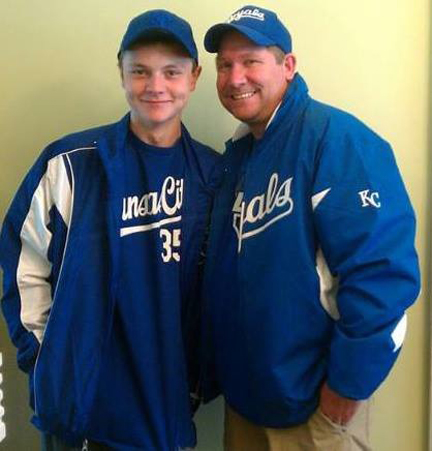
The 42-year-old has been a fan of the game all of his life and a fan of the Kansas City Royals ever since going to Kauffman Stadium as a little boy with his grandpa.

“This is where my love of the game comes from,” he said. “I love baseball because it’s a wholesome sport that brings me back to my childhood, simpler times and just good old fashion fun.”

And now he’s passing that love onto his son, Trystan, who attends all of the Royals’ games with him.

Lyle also coaches Trystan’s team during the summer.

“Watching my soon-to-be 15-year-old son play short stop is one of my favorite things to do in the world,” he said. “I’ve given up Royals front-row seats to watch my son play a pick-up game on a Saturday afternoon.”

In addition to watching his son and the Royals play, Lyle also enjoys learning about the history of his favorite team. He and Trystan frequently tour the Royals Hall of Fame at Kauffman Stadium.

“Kauffman is good about keeping the Hall of Fame fresh by adding new things,” he said.

He’s also been to the Missouri Sports Hall of Fame in Springfield and would love to see more of those types of venues, he said.

Last year, he had the opportunity of taking in the All-Star Fan Fest when the All-Star game was in Kansas City.

“It was amazing,” he said. “I felt like a little kid in a candy store.”

Over the years, he’s also compiled quite a baseball collection.

“My wife calls it my addition, not collection,” he said. “I own all the Kauffman Stadium giveaway Bobbleheads, which are also on display in the Hall of Fame.”
He has also renovated an entire room in his home just for his Royals collection which includes both vintage and new items, jerseys, toys, coolers, All-Star merchandise, broken game bats and “too much more to mention,” he said.

“It’s quite overwhelming and very impressive,” he continued. “I’ve spent a lot of time and money collecting it and finding just that right item here and there.”

Other fun baseball fan facts about Lyle include his favorite ballpark is Kauffman Stadium since that’s where the Royals play, his favorite ballpark food is a stadium hot dog and “The Bad News Bears” with Walter Matthau is his favorite baseball movie.

For Lyle, what baseball really means is wholesome fun with family and friends, he said, especially with Trystan.

“I’m so glad I’ve been given the opportunity to share my love of baseball with my son,” he said.

“Keeping the sport alive is up to the fans. I’ve got my part covered.”


Refracted: seeing life in a different light

 His spirit is willing but his body is weak.

Diagnosed with inoperable pancreatic cancer in August, Maryville resident Gus Rischer was told he had up to six months to live.

“I’m getting near the end of my road,” the soft-spoken 83-year-old said.

While his body has been failing him the last few months, his mind tells a different tale… still razor sharp as he shares his story… about his family, coming to Maryville, his stained-glass hobby and his decision to choose hospice care.

***

Originally from St. Louis, Rischer attended Pepperdine University and California State University, Los Angeles, for undergraduate and graduate degrees before returning to Missouri. In 1968, he began his tenure at Northwest Missouri State University where he was a psychology professor and chairman of the department for eight years before retiring in 1991.

He and his late wife, Katie, have three sons, Brad, Jon and Greg, and three grandchildren.

***

Rischer has been down the brutal and unforgiving cancer road before with his wife. So it was an easy decision to not have any of what he called “false kinds” of treatment like chemotherapy or radiation after his diagnosis.

“I watched my wife die with that,” he said. “It was a miserable process with her and I didn’t particularly look forward to experiencing it.”

He looked at what options were available and chose hospice care through SSM Hospice of Northwest Missouri in Maryville.

“I decided to take it as it comes and live in my own home until I can’t do it anymore,” he said.

***

In the last several months, the care given through hospice staff members has helped Rischer and his family deal with the reality of the prognosis.

It has also enabled him the time at home to go through his remaining stained-glass treasures, hundreds of pieces he’s crafted over the last 13 years, and give them to his children and grandchildren.

Frogs and teddy bears. Window hangings for the holidays. A slew of picture frames. And his personal favorites — two complete sets of ducks.

“I really enjoyed making the ducks,” he said. “I had spent hours and hours making them for myself.”

One set has now gone to his son, Brad, and the other will go to his son, Jon.

***

Walking around his home, showing off that set of stained-glass ducks which Jon hasn’t received yet, Rischer’s step is noticeably slower. And his voice a little more weathered. But brief moments of joy flash across his face as he describes in detail his love of the hobby.

It began when a friend of his was visiting Maryville.

“He was making figurines to hang in windows,” Rischer said. “So I asked him if he could teach me. Before he left, he had taught me how to cut glass, how to weld it and how to put it in a frame.”

***

Rischer completed his very first project, a stained glass window for his bathroom, on his friend’s next visit to town.
 Since that time, he said he’s made three to four hundred items, at least, which he’s given away.

“It was fun to learn and to watch myself progress and get better,” he said. “And then to see other people enjoy it.”

But because of the pain from pancreatic cancer over the last few months, his abilities have declined.

***

The hospice care staff has been wonderful in many ways, Rischer said, especially in helping him manage the pain.

“They’re a special kind of people,” he said.

One aspect he has especially enjoyed has been the time spent visiting with a pastor.

“I’m not a very religious person but the pastor who comes to visit, I enjoy his visits,” he said. “He’s a very intelligent man and we just talk, not necessarily anything religious. Maybe about something in the news. We enjoy each other’s viewpoints on daily happenings.”

***

Looking out Rischer’s front room window, the view unfolds the rolling hills and fields that are so characteristic of the Midwest landscape. The setting sun just above the horizon streams light into his stained-glass window.

The process of the artistry that went into that first project — and all of them since then — begins with picking out 12×12- or 12×14-inch pieces of glass.

After gluing a pattern of what he wants to make onto the glass, it is cut with a special glass cutter and the edges are smoothed with a grinder.

The pattern is then removed and copper foil is wrapped around all of the pieces which are put together like a puzzle, he said, one against the other so the soldering can begin.

When each of the pieces has been soldered on both sides of the glass, the project is finished by being cleaned and waxed.

“It’s an interesting, lengthy, multi-skilled process,” he said.

***

Rischer’s hospice care could also be described as a multi-skilled process. In addition to the pastor who visits an hour each week, he also has a social worker, physical therapist and a nurse who comes to his home every three days or whenever he needs more attention.

“Hospice is a wonderful organization,” he said. “And the one we have in Maryville is an award-winning organization.”

***

While Rischer saw his stained-glass artwork as simply a hobby, after many hours of practice, he’s been able to produce many beautiful and wonderful pieces.

To be truly enjoyed, stained glass depends on refracted light. Only after light passes through the glass can the beauty and wonder be seen.

Refraction is defined as a change in direction because of a change in the medium. It can also be defined as altering something by viewing it differently.

With stained glass, it is the turning or bending of the light when it passes through the colored pieces at different angles.

With Rischer, it has been the opportunity to see life in a different light through his hospice care, especially through the care given to him by his nurse.

“You have to be a special kind of nurse to be a hospice nurse and we’ve got some dandies,” he said. “Most nurses treat people so they can get well. Hospice nurses are treating me so I can get ready to pass on. And that takes a special kind of intelligence and skill and psychological makeup to deal with it.”


The gift of autism: Fox family helps spread autism awareness

Creed Fox knows all about tornadoes. He knows the wind speeds of an F-5 tornado and what kinds of clouds are in the sky.

The almost 10-year-old also knows about airplanes. He knows their military branch, their engine types and who makes them.

But the little boy who loves tornados and airplanes would not ride in an elevator. He also doesn’t play with neighborhood children, struggles with eye contact, has trouble with table manners and refuses to leave the house after he comes home from school.

Creed is one of the 54.

One in 54 boys who are affected by Autism Spectrum Disorder.

The Centers for Disease Control estimates that one in 88 children will be affected by an Autism Spectrum Disorder, and of those 88, one in 54 will be a boy. Creed was diagnosed in January 2011 at the age of 7 1/2.

Magical moments

While things may be more difficult at times for his family because of autism, it has also opened their eyes to what his mom calls “magical moments.”

“I find pleasure in watching him do things that excite him,” Maryville resident Penni Fox said. “As we were leaving school yesterday, our normal routine is to go to the post office. Well, I went a different way, which is not allowed, and we found two cement mixers pouring concrete into a newly dug basement hole.

“He was mesmerized as we talked about rebar and concrete and the workers doing the job.

“At a time before autism, I would have barely noticed the work taking place.”

Magical moments.

“Seeing things that are so unimportant to most people become magical moments to my son with autism,” Penni said. “That is the gift of autism.”

Elevators

Some people don’t see it that way, as a gift. But that’s what Penni and her husband, Chuck, are trying to do. Share their story and share their gift.

That little boy who can tell you everything about tornadoes and airplanes goes into an absolute panic when he nears an elevator.

It’s his latest autism hangup, Penni said, but he’s working on it with a specialist.

“He will now step inside it as long as someone holds the ‘door open’ button,” Penni said. “Then he examines the inside for the manufacturer and the capacity, whether it says number of people or a total weight limit, and he can remember who makes many of the elevators.”

The Foxes

Chuck and Penni Fox are natives of Northwest Missouri. In addition to Creed, they have an older son, Drake.

As a toddler, Penni said Creed was reaching his developmental milestones, although at the end of the window or even months later, but he was doing some amazing and bizarre things, too.

“I knew he was struggling but nothing was obvious enough to warrant testing for autism or anything else,” she said. “He was just a little quirky.”

They moved to Maryville in 2008 when Chuck retired from the Air Force. He worked as an assistant coach for the Northwest Missouri State women’s basketball team with former coach, Gene Steinmeyer. (See story on Creed and the team on page A1)

“Creed started kindergarten at Eugene Field that year, but he struggled,” Penni said.

Diagnoses

Soon, Creed received a diagnosis of dyslexia along with ADHD. He repeated kindergarten and Penni thought he was doing better, although he was still behind academically.

During the next year, however, Penni said she realized something was really wrong.

While discussing his academic performance with his teacher, Penni said she blurted out, “Do you think he has autism?”

The school district worked very hard to get a plan in place, she said, while they waited nearly four months for testing at Children’s Mercy in Kansas City and at the University of Kansas. He was diagnosed with high functioning autism.

“High functioning is the blessing in the autism diagnosis,” she said. “It means he is highly verbal, does most self care and has these out of the world understandings of the strangest things for a seven-year-old kid.”

During the early stages of his diagnosis, Penni said she kept reading about the “gift of autism.”

“At that point, I wasn’t sure it was a gift,” she said. “But it was a relief to know what was wrong with Creed.”

Toothpicks & drinking straws

Penni has chosen to work from home part-time so she can be available full-time for Creed. It means very little time away from him because he can’t be left with just anyone.

“Paying a teenager to watch TV while he plays is not a reality,” she said. “He may decide to build a recycling landfill by opening full garbage bags and burying them in the back yard.

“He might fill the bathtub with 25 plastic shopping bags to see if they float.

“He might make toilet paper sculptures in the bathroom sink then place them in areas his brother stores his possessions to dry.”

All true stories.

On the plus side, she said he loves art and anything that can become a sculpture, like that toilet paper, or even toothpicks and drinking straws.

Routine

Creed craves routine.

“He likes to drive the same route to our destination, tells me when I should get over, asks if I am watching for the exit and how fast am I going,” Penni said.

He also wants everyone else to follow rules, she said.

“It drives him crazy if Mr. Dumke keeps them just an extra minute or two past his scheduled departure time,” she said.

Creed is currently in Howard Dumke’s third grade class at Eugene Field. He is mainstreamed for special classes like PE, music and art and also has some regular classroom time. He receives speech, occupational therapy and social skills intervention.

“We are incredibly lucky to have the support we do from Eugene Field Elementary School,” Penni said.

In the early stages of this autism, he would become frustrated or agitated and have episodes of Echolalia, which is repeating random things he had heard, she said.

Now he’s focused on a six-rotation medley. He randomly shouts out digital clock times, like 5:09, and then backward, 9:05, for six rotations.

Gift of autism

Penni advocates for more support for mental and behavioral health in Maryville to help Creed and the other one in 54 like him.

“Being in this largely rural area, access to services for autism are nearly nonexistent,” she said.

She also hopes her efforts with awareness will help people understand and embrace autism.

“Our country has to understand and embrace the gift of autism and create and find suitable opportunities for these individuals,” she said. “In the right places, with the right training and support, individuals on the spectrum can be productive citizens.”

When people realize that potential, their eyes can open to see those magical moments that Penni sees with Creed.

It is the gift that is called autism.


Marching for a cause: program to celebrate Maryville ladies band

One hundred years after Alma Nash signaled the downbeat and her band began to play, quieting the unruly crowds gathered at the Women’s Suffrage Parade in Washington, DC, a group of Maryville High School young women will present a program to celebrate the achievement.

The Nodaway County Historical Society will host a Ladies Band Program at 2 pm, Sunday, March 3, at the museum, 110 North Walnut, Maryville.

The program will highlight the Missouri Ladies Military Band of Maryville who marched on March 3, 1913, the only all-women band to march and perform in the suffrage parade that day.

The event will feature 11 MHS students performing music as well as the opportunity to see a new exhibit at the museum on Nash.

Women’s Suffrage Parade

As the parade began in front of the Capitol Building on that day in early March, a crowd of heckling and resentful men refused to let the marchers move forward. The crowd, estimated at around 250,000, overwhelmed the police in the area.

That’s when Nash and her band began to play, quieting the crowd, and the parade moved ahead without incident.

Nash later told a Maryville reporter: “We did not have time to stop and think about the really important thing we did do when our band led the parade down Pennsylvania Avenue. We were not right in the lead when the parade started; a number of women escorts, a number of walking officers of the National Equal Suffrage Association, with our band following, was the order when we first started.

“We had gone but a short distance when the crowd started closing up toward the line of the parade, and men blockaded a place in the street a short distance ahead. One of the suffrage officers came rushing back to us and told us to march on ahead and lead; that it would be necessary for the band to open the way proved true.

“We were not molested in the least, and although the march was slow on account of the crowds, no one offered to stand in our way down the avenue.

“These women were part of one of many remarkable stands for women’s suffrage.”

Ladies Band

Several years before the parade, in 1905, Nash opened the Maryville School of Banjo, Mandolin and Guitar. Five years later, she organized an all-ladies concert band and then transformed that band into the first all-ladies marching band.

During this time, as women were strongly petitioning for suffrage, the leaders of several women’s groups decided to organize a parade in Washington to call more attention to their cause. The parade on March 3 was to precede the inauguration of President-elect Woodrow Wilson the following day.

The Maryville band members jumped at the opportunity to join in the suffragette cause.

A new discovery

An old, worn picture has been in Joyce Holt’s possession for many years, although she didn’t realize its significance until recently.

“It’s been in my old album forever, but I didn’t know what it was,” the 87-year-old Maryville resident said. “It just said Alma Nash and the Maryville band.”

Then a couple of weeks ago, Holt ran into Melissa Middleswart, a longtime friend and volunteer at the museum who had been busy planning the Ladies Band Program. And while discussing the event, the conversation soon turned to the photo.

They began to wonder if Holt’s mother, Edith Davenport, had been a member of the band since she was in possession of the photo.

After doing some digging, it was discovered that Davenport was a member of the band and involved in the local suffragette cause. However, for some unknown reason, she did not make the trip to march with the women in Washington.

Edith Davenport

Holt knows very little about her mother, just stories her grandmother and others have told her, because she died a few weeks after giving birth to her.

Davenport was born on April 15, 1895, and grew up in Maryville. She was a country school teacher and was a part of Nash’s band in her late teenage years.

“I always knew she played the piano beautifully,” Holt said.

In addition to the photo of the band, Holt also has a postcard her mother sent to her grandmother on February 13, 1914, when she was 18 years old. She wrote that she would not be home that night as she was “debating women’s suffrage.”

“Grandma never talked about suffrage being a big deal,” Holt said. “But she was trying to eek out a living and raise five kids.”

But it was obviously of great importance to Davenport. Holt also has a photo of her mother standing on a rock that’s painted with the words “Votes for Women.”

Suffragette Cause

In the book “Suffrage Comes to the Women of Nodaway County, MO,” Martha Cooper wrote: “The Missouri Ladies Military Band of Maryville did not initially set out to be the nation’s first all-female suffragist marching band, but the young women were in the right place at the right moment to take this place in history.”

It would be seven more years after the Missouri Ladies Military Band marched in the Women’s Suffrage Parade that women were finally granted the right to vote.

One member of the band, Maye Shipps Corrough, on hearing the good news while at the Arkoe general store, said: “I got up on the counter and danced!”

Corrough’s trombone is on display at the museum and will be available for viewing following the Ladies Band Program on March 3. The event is free, but donations are welcome. Refreshments will also be served.

The museum reopens from its winter closing on March 5 with regular hours of 1 to 4 pm, Tuesday through Friday, or by appointment.

For more information about the program, call Middleswart at 660.582.8687.

Information for this article came from a 1966 Kansas City Star article, “Tribute to a Music Teacher: Her Ladies Band Helped Suffragette Cause,” a 1984 KC Star-Times article, “Woman played to beat the ban on vote,” “Suffrage comes to the women of Nodaway County, MO” by Martha Cooper, and the Missouri Women blog. Special thanks to Melissa Middleswart and Joyce Holt.


Planning Christmas with Pinterest: decorations

Preparing for the holidays can sometimes feel overwhelming. The decorating, the creating, the baking. Then there’s the shopping to do and the wrapping. Add in the church services, parties and programs to attend and hosting get-togethers with families and friends.

The list of things to plan seems endless. And coming up with new ideas each year gets more and more difficult.

Here’s where Pinterest can help. The social media site lets users browse, share and organize things and ideas on the web. They can pin their interests on virtual bulletin boards.

Quitman resident Erin Mullins said she uses Pinterest to get ideas for crafts, cooking and photography and is a valuable tool around the holidays.

“With Christmas coming up, it’s a perfect spot to find something new,” Mullins said. “I usually give cookies or little gifts to my friends and neighbors and sometimes it’s hard to find new ideas so that you’re not giving the same thing each year. I’ve already pinned several ideas that I plan on using this year.”

Parnell resident Brooke Gray has also been busy this year pinning ideas she plans to use.

“I am using Pinterest ideas for Christmas gifts to save money and to get away from the commercial Christmas that so many are wrapped up in,” Gray said.

To help you out with your Christmas planning this year, the Nodaway News Leader has pinned a variety of ideas on our boards at pinterest.com/nodawaynews.

Decorations

The first way the NNL can help you this holiday season is with decorating. Our “Planning Christmas Decorations” board has a variety of decorating pins, from jingle bells and shiny balls to hanging stockings, jolly snowman and trees with all the trimmings. Check out pinterest.com/nodawaynews/planning-christmas-decorations.

Here are a few of those pins:

Seasons Greetings Wreath

This Seasons Greetings Wreath is from the Seasons of Joy blog. It can be made using many materials from a dollar store at a cost of around $16.

Items needed include a grapevine wreath, off-white spray paint, baby’s breath, a bird nest, birds, transparent off-white ribbon and ornaments.

For step-by-step instructions or more information, visit deckthehalls-christmas.blogspot.com/2011/11/seasons-greetings-wreath.html.

Mantle Decorations

There are endless ways to decorate a mantle during the holidays and Holly Mathis Interiors has one idea using fresh greenery.

Starting with the greens, she added natural wood nutcrackers, plaid bows, burlap stockings and a large canvas picture with a Christmas phrase printed on it.

To read more about this idea, visit hollymathisinteriors.com/2011/12/welcome-christmas-tour.

Decorating Your Tree

These tips to help decorate your tree like a professional come from The Yellow Cap Cod website.

Designer Sarah Macklem says there are no rules when it comes to holiday decorating but it’s all about family traditions. Still, she has a few guidelines to get you started which include using the right bulbs, colors and textures of ornaments, finding graphic elements like the large snowflakes and adding unusual elements like the framed monogram.

For more about her ideas, visit theyellowcapecod.com/2011/11/holiday-home-series-tips-decorate-your.html.


A jury of their peers: Service of 12 leaves lasting impact

“All rise,” the bailiff bellows, echoing throughout the dark and dated courtroom. “The court is now again in session.”

Members of the jury file in slowly and take their seats in the jury box.

Draped in a long, black robe, the judge asks everyone to please be seated.

The long, wooden benches creak as those in the audience try to get comfortable once again.

Lawyers shuffle papers and whisper with one another, comparing notes before the bantering begins.

“It’s inherently dramatic,” Nodaway County Prosecuting Attorney Robert Rice said. “Sometimes you’ll work six months or over a year on a single case. And then you get 12 people who have never heard anything about it and they have to make a decision that impacts (a person’s) life. There are significant consequences.”

Right…to a jury trial

The jury system in the United States can be traced back to 12th Century England when King Henry II used a jury for their knowledge of a particular case. It evolved in the 15th century when Henry VI turned the jury into the trier of the evidence.

The colonists brought these ideals with them to America and the right to a jury trial was included in all 13 of the original states’ constitutions and in the Sixth Amendment to the US Constitution.

The Missouri Constitution grants everyone the right to a trial by jury in both criminal and civil cases (see the adjacent box, Jury Service Glossary). With criminal cases, this right only applies to serious crimes, which carry a potential sentence of more than six months.

Right…here in Nodaway County

The Nodaway County Courthouse sits in the very center of Maryville on the downtown square and very nearly the center of the county.

Built in 1881, the red brick structure, trimmed in sandstone with a renovated cupola and clock tower, stands as a beacon of the county and has been listed on the National Register of Historic Places.

Once visitors make the climb up the large marble stairs to the second floor, they are advised to turn off cell phones and pagers and have no food or drink before entering either one of the Nodaway County Circuit Court courtrooms.

On this particular fall day, a civil case is being heard by Circuit Judge Roger Prokes and jurors have just returned from a lunch break.

Five men. Seven women. Ranging in age from their early 20s to their 70s. One alternate. A man in his 30s.

Yellow badges identify each juror with a number, not their names.

Some look around at the audience. Some grab notepads to resume notetaking. Some look out the windows to the world outside.

And then the case resumes once again.

Right…time for civic responsibility

Serving on a jury can be seen as a civic responsibility. For Thomas Jefferson, it was more important than all other civic duties including voting.

“I consider trial by jury as the only anchor yet imagined by man by which a government can be held to the principles of its constitution.”

Today, the jury system continues to depend on the service of American citizens.

While a jury trial can be inconvenient for many, Rice believes it’s important for a community to have them.

“A jury trial is a lot of people putting in a lot of time and it’s inconvenient for a lot of folks,” Rice said. “But I think we do that, though, so people are kept accountable whenever they do wrong.”

Editor’s note: this is the first in a series about jury trials. In the coming weeks, we’ll explore the role of jurors, the trial process and more. Some information for this article came from the Missouri Bar Association, mobar.org, and the Missouri Courts System, courts.mo.gov.